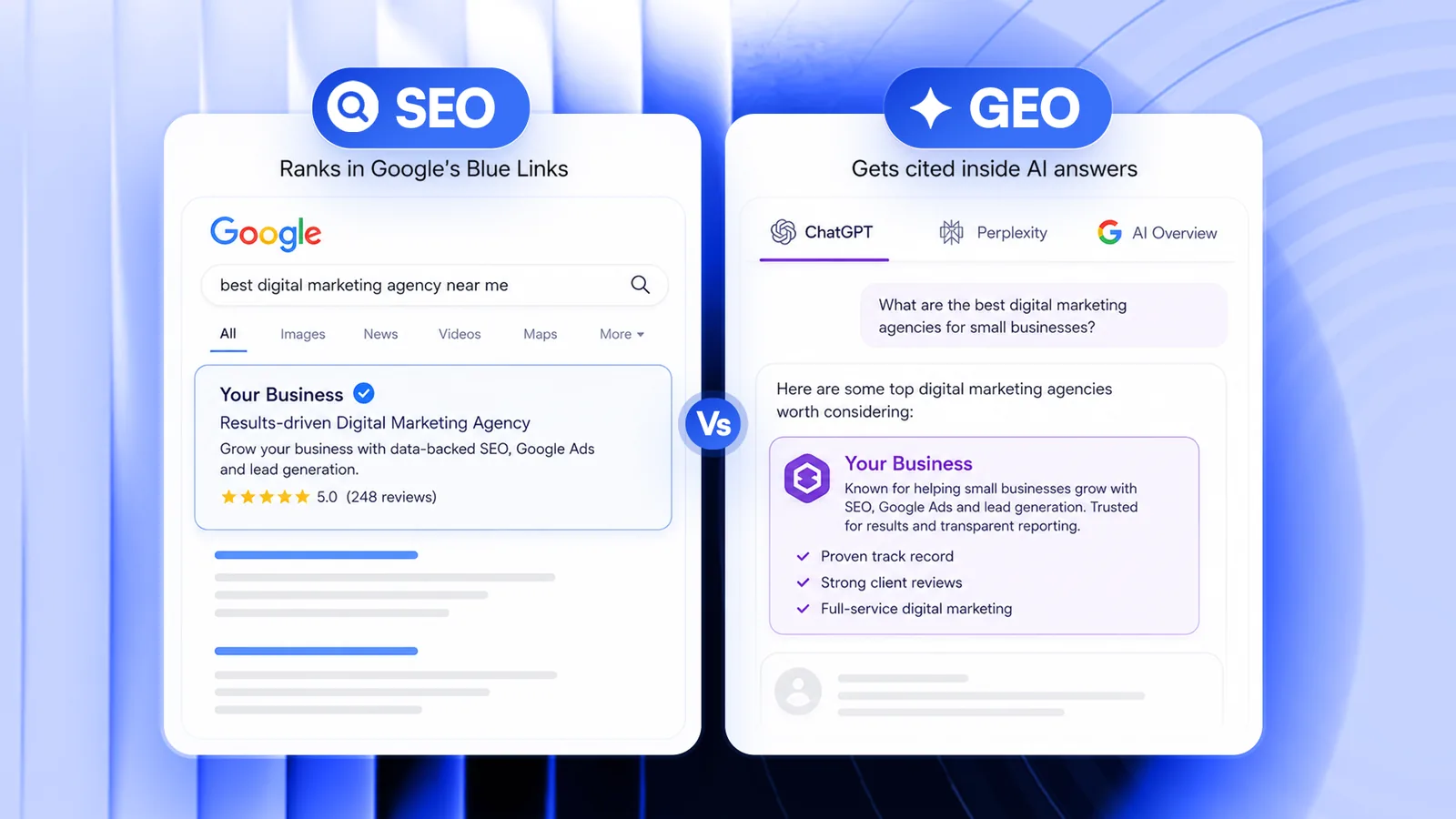
SEO (search engine optimization) gets your website to rank in Google’s blue links so people click through to you. GEO (generative engine optimization) gets your brand cited inside AI answers from tools like ChatGPT, Perplexity, and Google’s AI Overviews. They share the same goal, being found, but they target different places and they’re measured differently. GEO isn’t replacing SEO. The two work together, and in 2026 a small business that wants to be found needs both. Here’s how they differ, how they overlap, and exactly what to do about it.
The reason this matters now: a growing share of searches never reach a list of links anymore. People ask ChatGPT, or they read Google’s AI Overview and stop there. If your business only shows up in the blue links, you’re invisible to everyone who never scrolls that far. GEO is how you show up in the answer itself.
What is SEO?
SEO is the practice of getting your web pages to rank in traditional search results on Google, Bing, and YouTube. It works through keywords, quality content, technical health, and backlinks that build your site’s authority. The goal is a click: someone searches, sees your page near the top, and comes to your website. Success is measured in rankings, click-through rate, and organic traffic. SEO has been the backbone of online visibility for two decades, and it still is.
What is GEO (generative engine optimization)?
GEO is the practice of getting your brand, content, and products cited inside AI-generated answers. When someone asks ChatGPT “what’s the best marketing agency for a small business,” or reads a Google AI Overview, GEO is what makes your business one of the sources the AI names. It works through clear, direct answers to real questions, structured content the AI can parse, and consistent mentions of your brand across the web that build the trust these systems look for. Success is measured differently: citations, share of voice in AI answers, and brand mentions, rather than clicks.
GEO vs SEO: the core differences
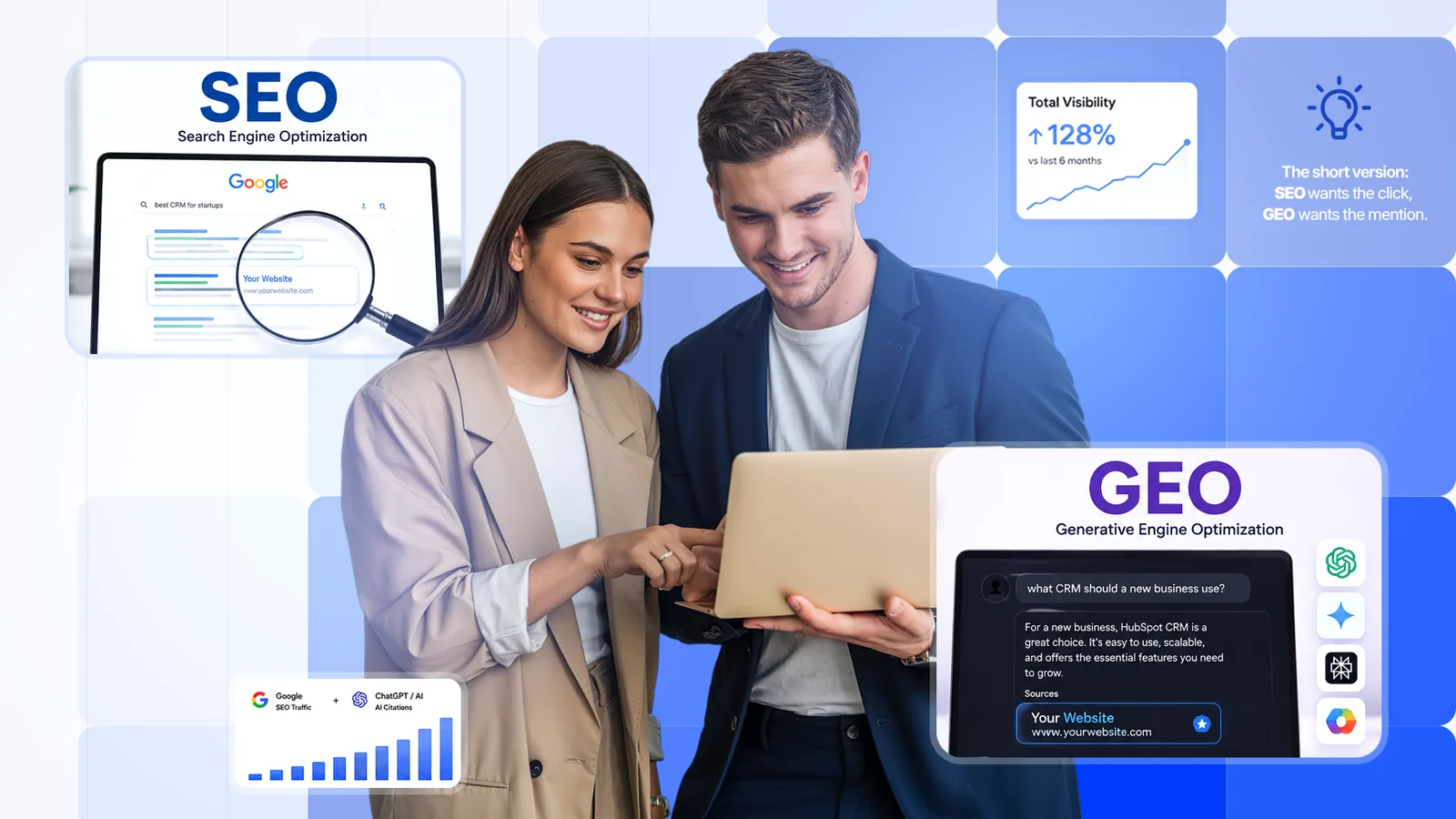
Here’s the difference at a glance:
| Feature | SEO | GEO |
|---|---|---|
| Where it works | Google, Bing, YouTube | ChatGPT, Gemini, Perplexity, AI Overviews |
| The goal | Rank in the results so users click to your site | Get cited as a trusted source inside the answer |
| The input | Short keywords (“best CRM for startups”) | Conversational questions (“what CRM should a new business use?”) |
| How you win | Keywords, content, backlinks, technical health | Clear answers, structure, brand mentions, authority |
| How it’s measured | Rankings, click-through rate, organic traffic | Citations, share of voice, AI mentions |
The short version: SEO wants the click, GEO wants the mention. One sends people to your site, the other puts your name in the answer they read on the way.
How GEO and SEO work together
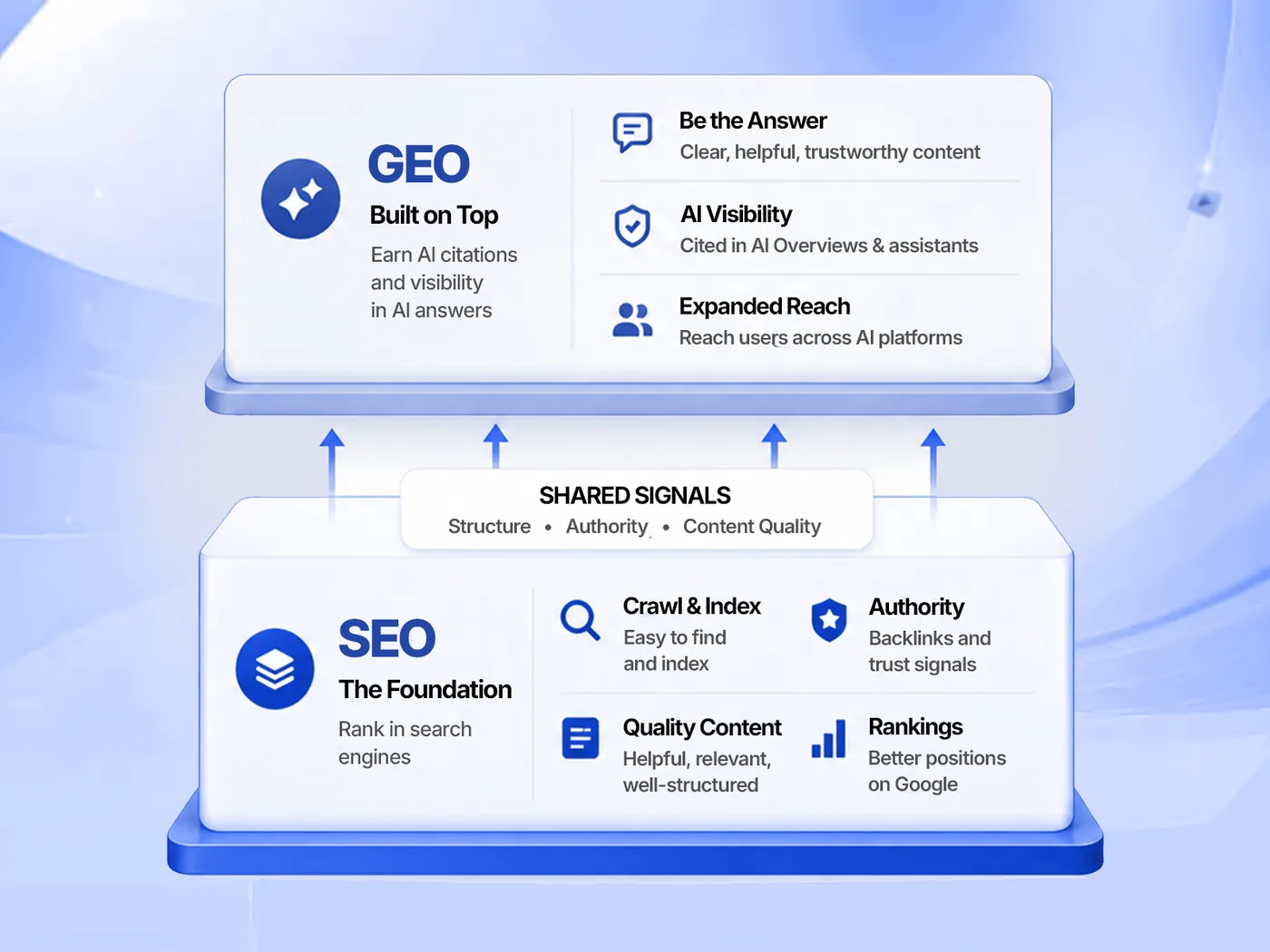
Here’s the part the “SEO is dead” headlines get wrong: GEO and SEO aren’t rivals. Strong SEO is the foundation GEO is built on. AI systems learn what to cite by reading the same web, leaning on the same structured data, the same authority signals, and often the same search indexes that SEO already optimizes. A page that’s well-structured, trustworthy, and clearly written tends to do well in both places.
But ranking on Google doesn’t automatically get you cited by AI, and that’s the gap GEO fills. You can be the number one blue link and still be missing from the AI Overview above it. The businesses that win in 2026 do both: they earn the ranking and they earn the citation.
How to optimize for both (2026 checklist)
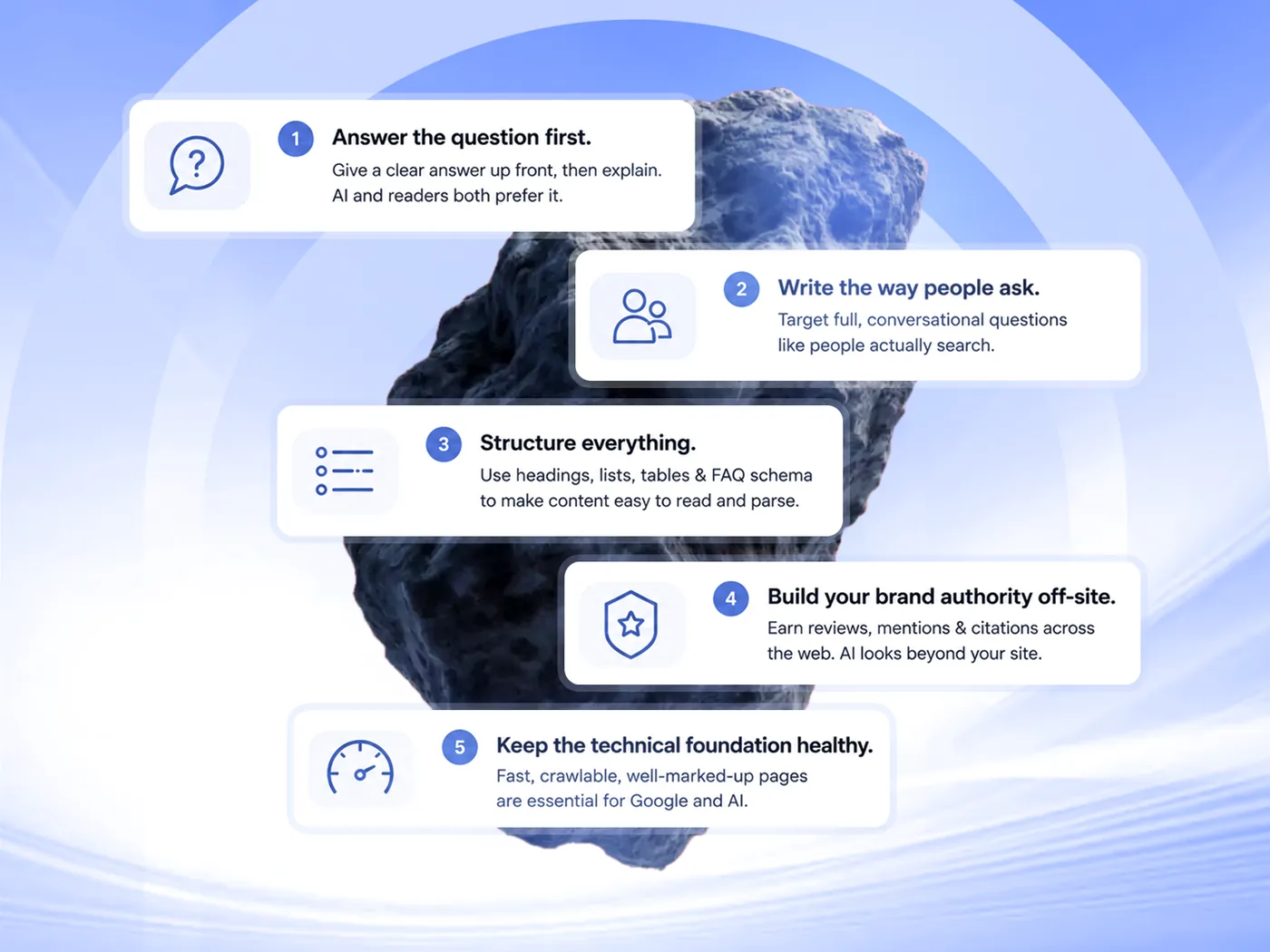
The good news is that most of what helps GEO also helps SEO, so you’re rarely choosing between them. Here’s what actually makes the difference:
- Answer the question first. Open each page or section with a clear, direct answer, then explain. AI systems lift clean answers, and readers do too.
- Write the way people ask. Target the full conversational question, not just a short keyword. “How much does a marketing agency cost” beats “agency cost.”
- Structure everything. Clean headings, short paragraphs, lists, tables, and FAQ schema make your content easy for both Google and AI to parse and quote.
- Build your brand’s authority off-site. AI cross-references reviews, forums, and mentions across the web before it cites you. Consistent, credible mentions matter as much as your own page.
- Keep the technical foundation healthy. Fast, crawlable, well-marked-up pages are the price of entry for both. If Google can’t read it cleanly, neither can the AI.
Do these well and you’re optimizing for the blue links and the AI answer at the same time. That’s the whole point: one body of work, two kinds of visibility.
Is GEO replacing SEO?
No. GEO is expanding what “being found” means, not replacing the foundation. Search isn’t disappearing, it’s splitting into more surfaces: traditional links, AI Overviews, and standalone AI tools. SEO still drives the clicks that most businesses depend on, and it still feeds the authority that GEO relies on. Treating GEO as a reason to abandon SEO is how businesses vanish from both. The right move is to keep your SEO strong and add GEO on top, so you show up wherever your next customer is looking.
What this means for your small business
You don’t need two separate strategies or two separate budgets. You need one program that earns rankings and citations together, run by people who understand both. That’s how Lotiva approaches it: the SEO work that ranks you on Google is built to also get you cited in AI answers, on flat pricing from $2,000 a month. It’s one engine, tuned for a search world that now lives in two places.
You can see how the whole picture fits together in our guide to the best marketing agencies for small businesses, or price a plan on the pricing page. Our SEO services build both into one plan.
The fastest way to know where you stand is to see it. Book Your Free Call and you’ll get a real read on how visible you are in both search and AI answers, and what to fix first, whether you hire us or not.
See how visible you are in search and AI answers
Get a free marketing audit and a real read on where you stand in Google and in AI answers, whether you hire us or not.
Frequently asked questions
What is the difference between GEO and SEO?
SEO gets your website to rank in traditional search results like Google’s blue links, so people click through to you. GEO gets your brand cited inside AI answers from tools like ChatGPT, Perplexity, and Google’s AI Overviews. SEO wants the click, GEO wants the mention. They share the goal of being found but target different places and are measured differently.
Is GEO replacing SEO?
No. GEO adds a new surface to be found on, but it doesn’t replace SEO. AI systems rely on the same authority, structure, and indexes that SEO builds, so strong SEO is the foundation GEO sits on. The businesses that win in 2026 keep their SEO strong and add GEO on top rather than choosing one.
What does GEO stand for?
GEO stands for generative engine optimization. It’s the practice of optimizing your content and brand so that generative AI tools like ChatGPT, Gemini, Perplexity, and Google’s AI Overviews cite you as a trusted source in their answers.
How do I optimize for AI search and AI Overviews?
Answer questions directly and early, write the way people actually ask, structure your content with clean headings and FAQ schema, build consistent brand mentions across the web, and keep your site technically healthy. Most of this also improves your traditional SEO, so you’re optimizing for both at once.
Do small businesses need GEO in 2026?
Yes, because a growing share of searches now end in an AI answer instead of a list of links. If your business only appears in the blue links, you’re invisible to everyone who reads the AI Overview and stops. GEO makes sure your brand shows up in the answer itself, alongside your regular search rankings.
Can I do GEO and SEO with one agency?
Yes, and it’s usually the smarter choice. Because GEO and SEO share so much of the same work, a single program run by one team is more efficient than splitting them. Lotiva builds both into one flat plan so your rankings and your AI citations grow together.

Lily Andrews
Founder of Lotiva. Over a decade helping small businesses grow with SEO, paid ads, and AI-driven marketing. Connect on LinkedIn.