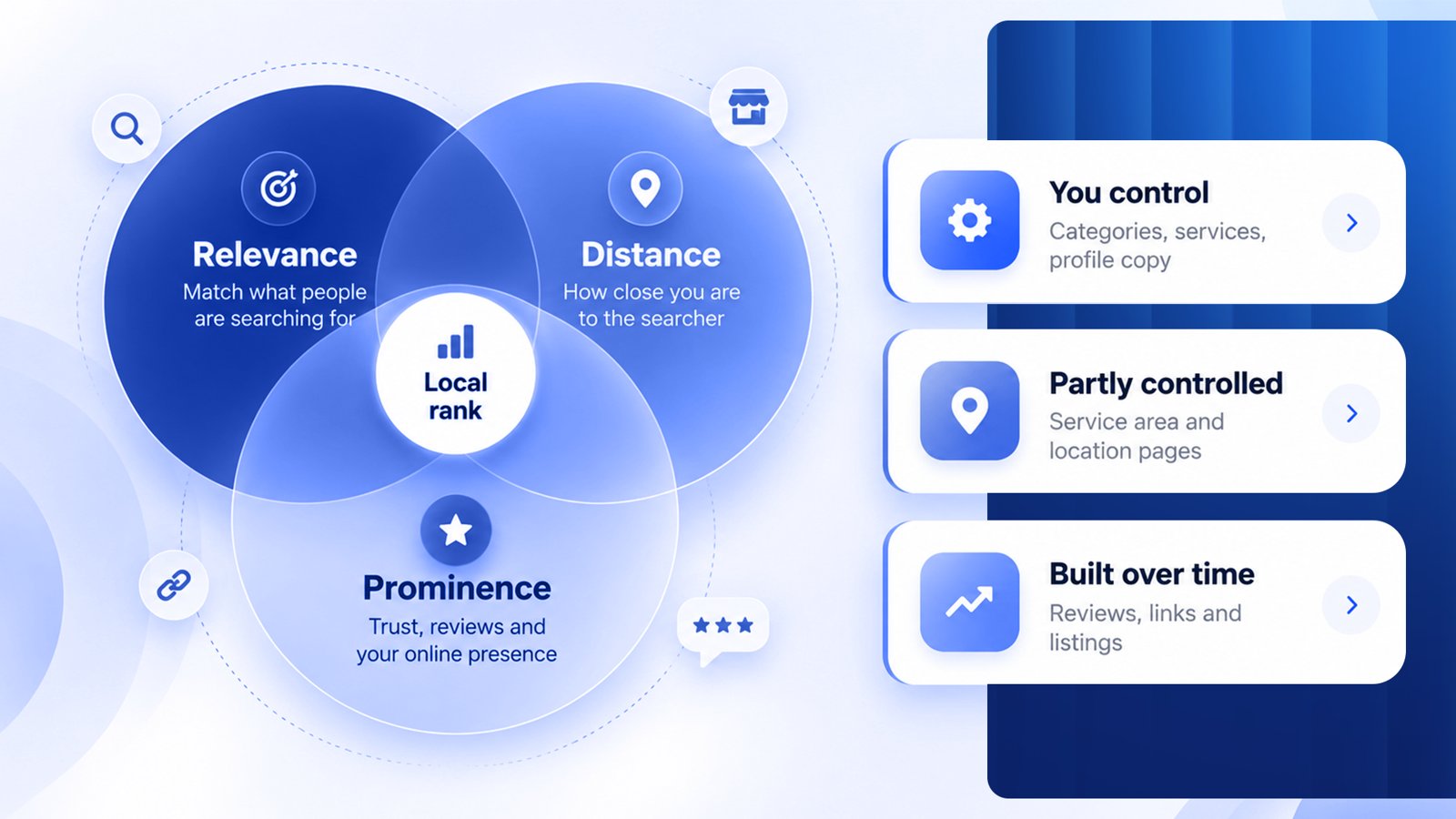
Local SEO is the work of making your business the obvious answer when someone nearby searches for what you do. For a small business that means showing up in the three-slot map pack, keeping a complete and active Google Business Profile, earning recent reviews, having a page for each area you serve, and keeping your name, address, and phone number consistent everywhere they appear online. Google says it ranks local results on three signals: relevance, distance, and prominence. Almost everything in this guide is a way to strengthen the two you can control.
Below is how local ranking works, what each piece of the work does, which parts you can handle in-house, and a 30-day plan to get the foundation in place.
The Three Signals Behind Every Local Ranking
Google publishes what it weighs in local results, which is rare. Its Business Profile help pages name three factors.
Relevance is how well your business matches what someone typed. A profile with the right categories, a full services list, and a description written in plain customer language gives Google more to match against.
Distance is how far your business sits from the searcher or from the place they named. You can’t move your building, but you can make sure your service area is set correctly and that each area you cover has its own page.
Prominence is how well known your business appears to be, online and off. Reviews, mentions on other websites, links, and consistent listings all feed it. This is where most of the ongoing work lives, because prominence accumulates rather than switching on.
A business with strong relevance and prominence can outrank a closer competitor. A business with neither will lose to one down the street that has both.
Where Local Buying Decisions Get Made
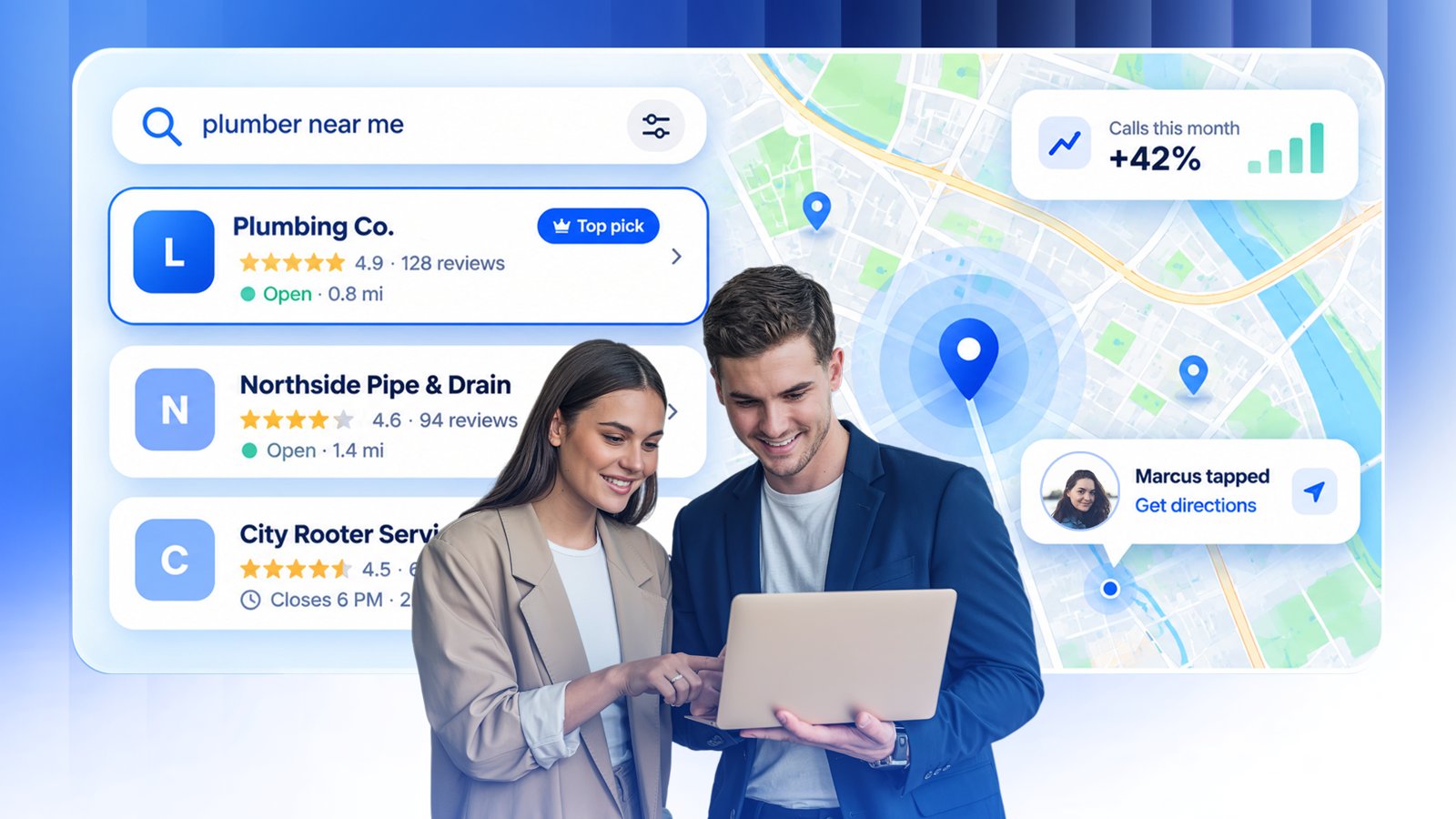
For a local search, Google shows a map with three businesses above the regular results. That group is the map pack, and it collects a large share of the calls, direction requests, website visits, and bookings for the search. Ranking first in the blue links below it matters less than being one of the three names on the map.
The map pack is built almost entirely from Google Business Profile data: your categories, your reviews, your hours, your photos, and the signals Google reads about you elsewhere. Your website supports it, but the profile is what gets shown. That’s why the profile comes first in every local plan.
The Profile That Does Most of the Work
Your Google Business Profile is free, and for many small businesses it produces more phone calls than the website does. It’s also the piece most often left half finished after setup. Every empty field is a question Google can’t answer about you.
The parts that move rankings and conversions:
- Categories. Your primary category is the strongest single relevance signal. Check what the businesses currently in the map pack use, and choose secondary categories for every real service you offer.
- Services and products. List each one individually with a short description written the way customers describe it.
- Photos and video. Active profiles outperform static ones. Add real photos of the work, the team, the location, and the equipment on a schedule, not once.
- Posts. Short updates, offers, events, and announcements keep the listing current and give Google fresh content to read.
- Questions and answers. Seed the common ones yourself so the answers are accurate, and respond when customers add more.
- Hours and attributes. Holiday hours, accessibility, payment options, and service-area settings all affect who Google shows you to.
Reviews as a Ranking Signal and a Sales Signal
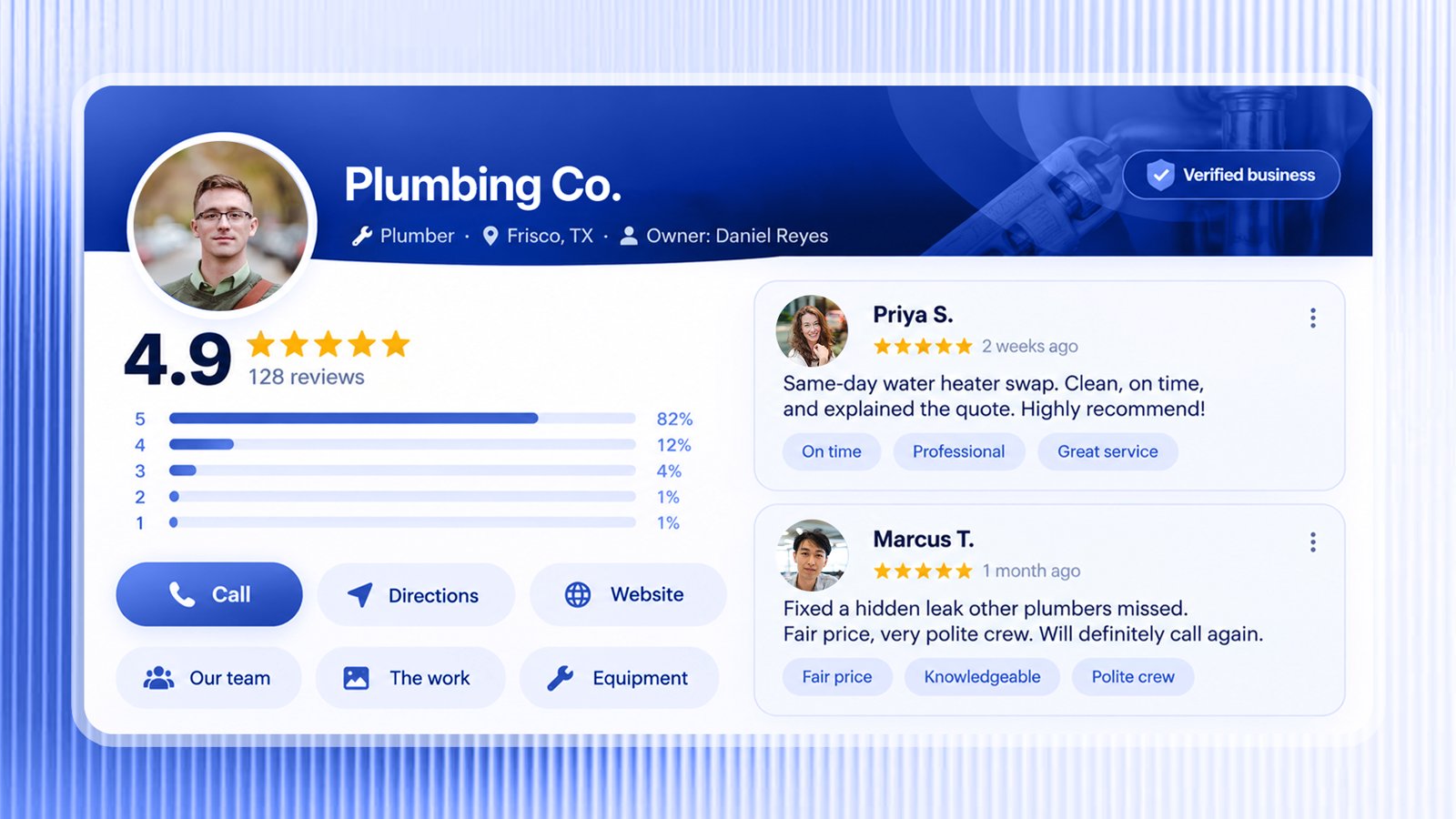
Reviews do two jobs. Google reads their count, their recency, their rating, and whether the business responds, and it folds all of that into prominence. Customers read the same reviews to decide whether to call. A profile with 80 reviews and nothing new in a year tends to lose to one with 40 reviews and three from last month.
The process matters more than any single review. Ask at the moment the customer is happiest, usually right after the job or visit. Make it a one-tap link. Respond to every review, including the difficult ones, in a calm tone, because future customers read the responses as closely as the reviews. Never buy or script reviews. Google removes them and can suspend the profile.
Location and Service Pages That Rank on Their Own
The profile wins the map pack. The website wins the regular results underneath it and gives Google the detail the profile can’t hold. Two kinds of pages do most of that work.
Service pages explain one service each, in depth, with the questions customers ask before they buy. “Plumbing” as a single page splits its strength across every job you do. “Water heater replacement” as its own page can rank for the people searching exactly that.
Location pages cover each city or neighborhood you serve. A business in Frisco that also works in Plano, McKinney, and Allen needs a page for each, with real local detail, not the same paragraph with the city name swapped. Our own Frisco page is an example of the shape.
Every page should carry your business name, address, and phone number, local business schema so Google and AI tools can read your details cleanly, and a clear way to call or book.
Consistent Business Details Across the Web
A citation is any place your business name, address, and phone number appear online: directories, maps apps, industry sites, the chamber of commerce, social profiles. Google cross-checks them against your profile. When the details match everywhere, Google is confident about the business behind the listing. When your phone number appears three different ways and an old address lingers on two directories, that confidence drops, and so can your ranking.
The work is unglamorous and it matters. Audit where you’re listed, correct what’s wrong, remove duplicates, and keep the format identical down to the suite number and the way the street name is abbreviated.
Local Links and Mentions
Links from other websites in your area or your industry tell Google that real organizations vouch for you. Sponsoring a youth team, joining the local business association, being covered in the city paper, partnering with a complementary business, and earning a mention from a supplier all count. Each one is a small signal. Together they separate a well-optimized profile from a well-known business.
Local Recommendations From AI Assistants
A growing number of people now ask ChatGPT, Gemini, or Google’s AI Overviews for a local recommendation instead of scanning a results page. Those tools cite businesses they can read and verify: a complete profile, consistent listings, recent reviews, and clear pages that answer questions directly. The same work that wins the map pack is what gets a business named in those answers, which is why we treat AI SEO as part of local SEO rather than a separate project.
The Work You Can Do In-House
Plenty of local SEO is within reach of an owner with a free afternoon. Claiming and completing the Google Business Profile, choosing categories, uploading photos, setting up a review request link, and fixing your details on the major directories are all doable without an agency.
The parts that tend to stall are the ones that repeat. Reviews need asking for every week and posts need publishing every month. Listings drift and need correcting, location pages need writing and updating, and links need earning. Most owners can do the first week of the work well. The question is whether there’s time for the next fifty-one, and that’s usually the point where a plan makes sense. Our local SEO services cover that ongoing work inside every plan.
A 30-Day Local SEO Plan
Here’s a sequence a small business can run in a month, in the order that produces the fastest movement.
Week 1: the profile. Claim or verify the Google Business Profile. Set the primary and secondary categories against what’s ranking in your area. Fill every field: services, products, description, hours, attributes, service area. Upload at least ten real photos.
Week 2: reviews and details. Create a short review link and build it into your follow-up. Ask every customer from the past month. Respond to every existing review. Write down your exact name, address, and phone format and check it against your website, Facebook, Yelp, Apple Maps, Bing, and the top three directories for your industry. Fix every mismatch.
Week 3: the website. Confirm the site is fast on mobile and that the phone number is clickable. Add local business schema. Pick the one service that brings in the most revenue and give it a page of its own if it doesn’t have one. Draft a location page for the second-most-important area you serve.
Week 4: prominence. Publish two Google Posts. Join one local organization that lists members online. Reach out to one partner or supplier for a mention. Review the first month’s profile insights to see which searches and actions are growing.
After 30 days the foundation is in place. Local SEO then becomes a steady routine: weekly review asks, monthly posts and photos, a new service or location page each month, and a quarterly check on listings and rankings.
Want a second set of eyes on your local presence?
Book a 30-minute call. We’ll look at how you rank across your service area, what’s holding the profile back, and what order to fix it in.
Common questions
How much does local SEO cost for a small business?
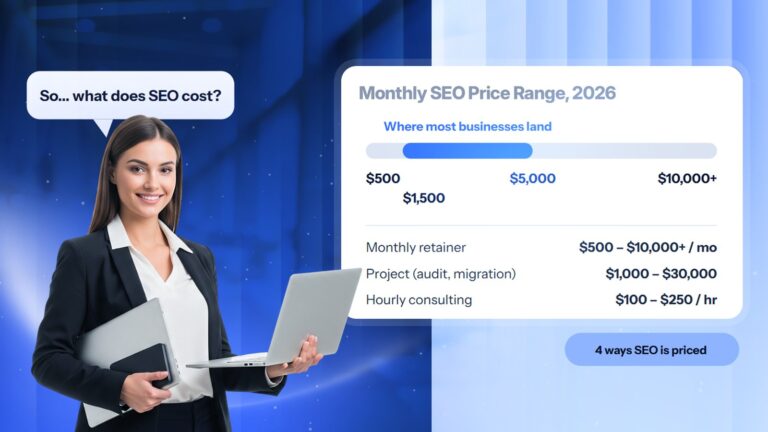
Published 2026 guides put local SEO at $1,000 to $5,000 a month depending on competition and the number of locations, with most single-location businesses at the lower half. With Lotiva, local SEO is included in every SEO plan, which start at $2,000 a month. Details are on our SEO pricing page.
Is local SEO worth it for a small business?
If your customers are nearby and they search before they call, yes. Local SEO targets people who are close and ready to buy, the map pack carries most of the clicks for those searches, and the work compounds, so the position you earn keeps producing without a per-click cost.
What’s the difference between local SEO and Google Local Services Ads?
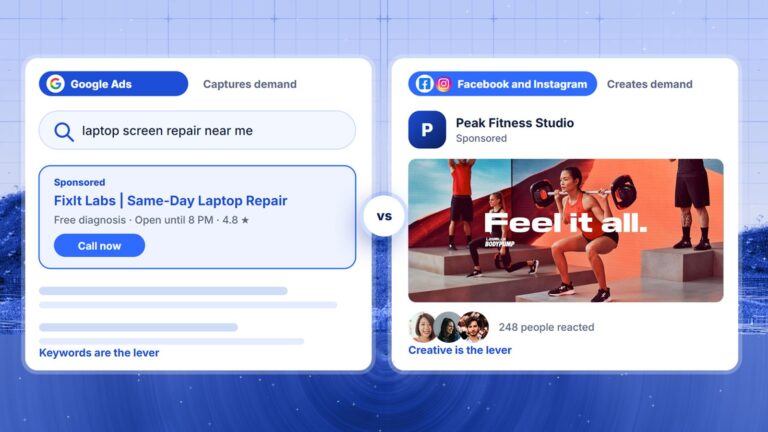
Local Services Ads are paid listings that appear above the map pack for certain service categories, and you pay per lead. Local SEO earns a place in the map pack and the organic results without a per-lead charge. Many businesses run both, with the ads covering demand while the organic position builds.
How many reviews do I need to rank in the map pack?
There’s no fixed number. Google weighs recency, rating, and responses alongside the count, so a steady flow of recent reviews with replies usually outperforms a large but stale total. Aim for a repeatable process rather than a target.
Do local citations still matter in 2026?
Yes, though less as a ranking lever on their own and more as a trust check. Consistent business details across the web confirm your identity to Google and to AI assistants. Inconsistent details create doubt, and doubt costs visibility.
How fast does local SEO show results?
Profile and listing fixes can show movement within a few weeks, which makes local one of the faster areas of SEO. Competitive metros and multiple locations build over several months because reviews and prominence accumulate rather than switching on.

Lily Andrews
Founder of Lotiva. Over a decade helping small businesses grow with SEO, paid ads, and AI search. Connect on LinkedIn.