
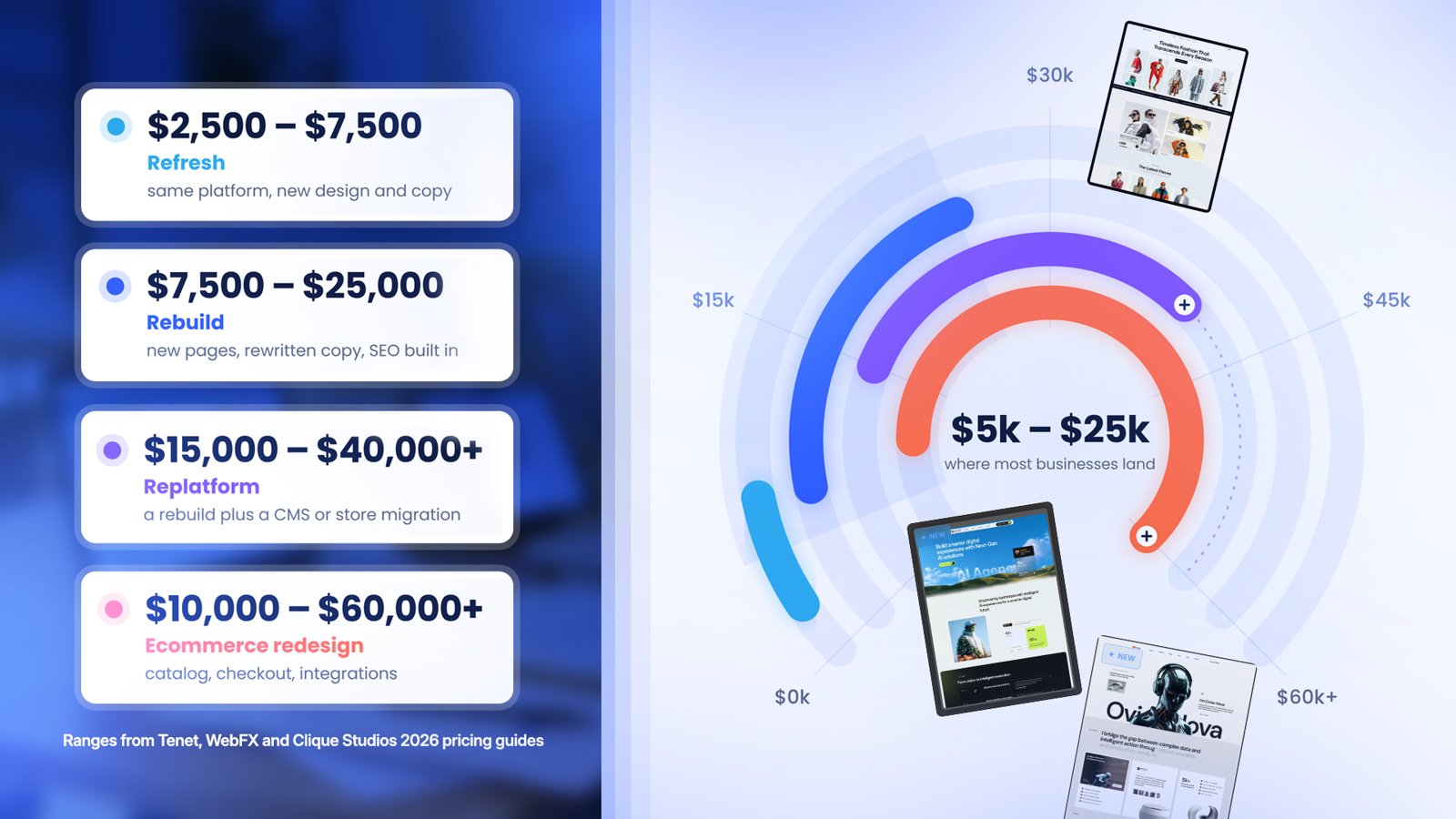
A website redesign costs most small and mid-size businesses between $5,000 and $25,000 in 2026. A focused refresh of an existing site, keeping the structure and updating the design, copy, and speed, runs $2,500 to $7,500. A full rebuild on a new platform with new pages and new content runs $10,000 to $40,000, and ecommerce redesigns start around $10,000 and climb with the size of the catalog. Those ranges come from pricing guides published this year by Tenet, WebFX, and Clique Studios, and from our own project pricing.
The number matters less than two questions that sit around it: whether the site needs a redesign at all, and how to do one without losing the search traffic the old site earned. This guide covers all three.
The Signs a Site Is Ready for a Redesign
Most websites don’t fail. They fall behind, slowly, until a competitor’s site makes the difference obvious. These are the conditions that usually mean a redesign will pay for itself.
- It’s slow on a phone. More than half of visits come from mobile, and a page that takes four seconds to load loses a large share of them before anything renders. Speed is also a ranking factor.
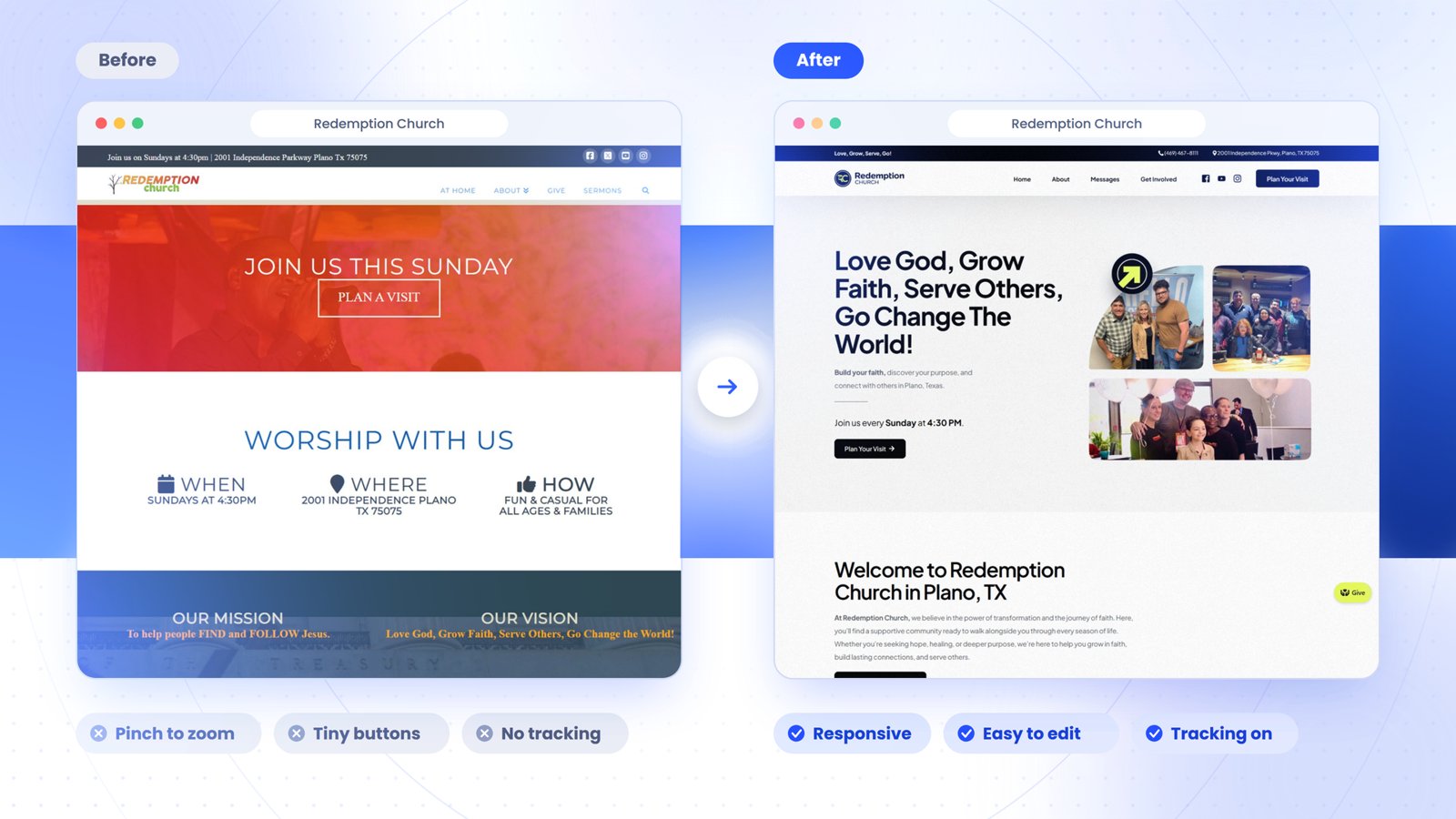
- It doesn’t adapt to screen size. Pinching to zoom, horizontal scrolling, buttons too small to tap. A site built before responsive design became standard is costing visits every day.
- Visitors arrive and don’t act. Traffic is steady but calls, forms, and orders aren’t. When the content and the offer are sound, a flat conversion rate usually points at the layout, the page structure, or the path to the call to action.
- The platform is holding you back. An old builder, an abandoned theme, plugins no longer updated, or a site only the original developer knows how to edit. When a small change takes a week, the site has become a cost center.
- The brand has moved on. New services, a new name, a new market, or a look that no longer matches the business people meet in person.
- Rankings have slipped and the fixes don’t stick. Technical problems baked into the template, thin pages, duplicate content, or a structure Google struggles to crawl. Some of these can be patched, and some need a new foundation.
- Tracking is missing or broken. If you can’t see which pages produce leads, every other marketing decision is a guess. A redesign is the natural moment to wire analytics and conversion tracking correctly.
Two or more of these together usually justify the project. One alone can often be fixed without a full redesign, which is worth knowing before you spend.
What a Redesign Costs by Scope
“Redesign” covers three different projects, and the price follows the scope more than the size of the business.
| Scope | What it includes | Typical 2026 cost |
|---|---|---|
| Refresh | Same platform and structure, new visual design, updated copy, speed and mobile fixes | $2,500 to $7,500 |
| Rebuild | New design, restructured pages, rewritten copy, SEO and tracking built in, same or new platform | $7,500 to $25,000 |
| Replatform | Everything in a rebuild plus a migration to a new CMS or commerce platform, with full URL mapping | $15,000 to $40,000+ |
| Ecommerce redesign | Product and category structure, checkout, integrations, catalog migration | $10,000 to $60,000+ depending on catalog size |
Ranges drawn from Tenet, WebFX, and Clique Studios 2026 pricing guides. Agency hourly rates in the US run $150 to $225 an hour.
Our redesigns are priced the same way as new builds, by page count, with research, copy, custom graphics, SEO, and tracking included in every one. A five-page business site is $6,750, a ten-page site is $12,750, and a store with up to 100 products is $16,650. The full table is on the website design pricing page.
What Moves the Price
- Page count. The single biggest factor. Ten unique pages cost more than five, and fifty cost more again. Templated pages such as location pages cost less per page than one-off layouts.
- Content. If the existing copy is strong, it carries over. If it needs rewriting around the keywords your buyers use, that’s professional writing time, and published guides put a full rewrite at $5,000 to $15,000 on its own. Our builds include the copy.
- Platform change. Moving from one CMS or store platform to another adds migration work, redirect mapping, and testing. It’s often worth it, and it’s never free.
- Custom features. Calculators, booking systems, portals, integrations with a CRM or inventory system, and anything with logic behind it adds development time.
- Design depth. A refreshed template is quicker than custom layouts for every page type. Custom graphics, photography, and video add cost and usually add conversion.
- Who does the work. A freelancer is cheaper per hour than an agency and carries more risk on the pieces that aren’t design: SEO migration, tracking, copy, and the handoff.
Protecting Your Rankings During a Redesign
This is the part most redesign quotes skip and the part that costs the most when it goes wrong. A site that has ranked for years has earned links, indexed URLs, and page-level signals. Change the URLs without a plan and all of that points at pages that no longer exist.
The process that protects it:
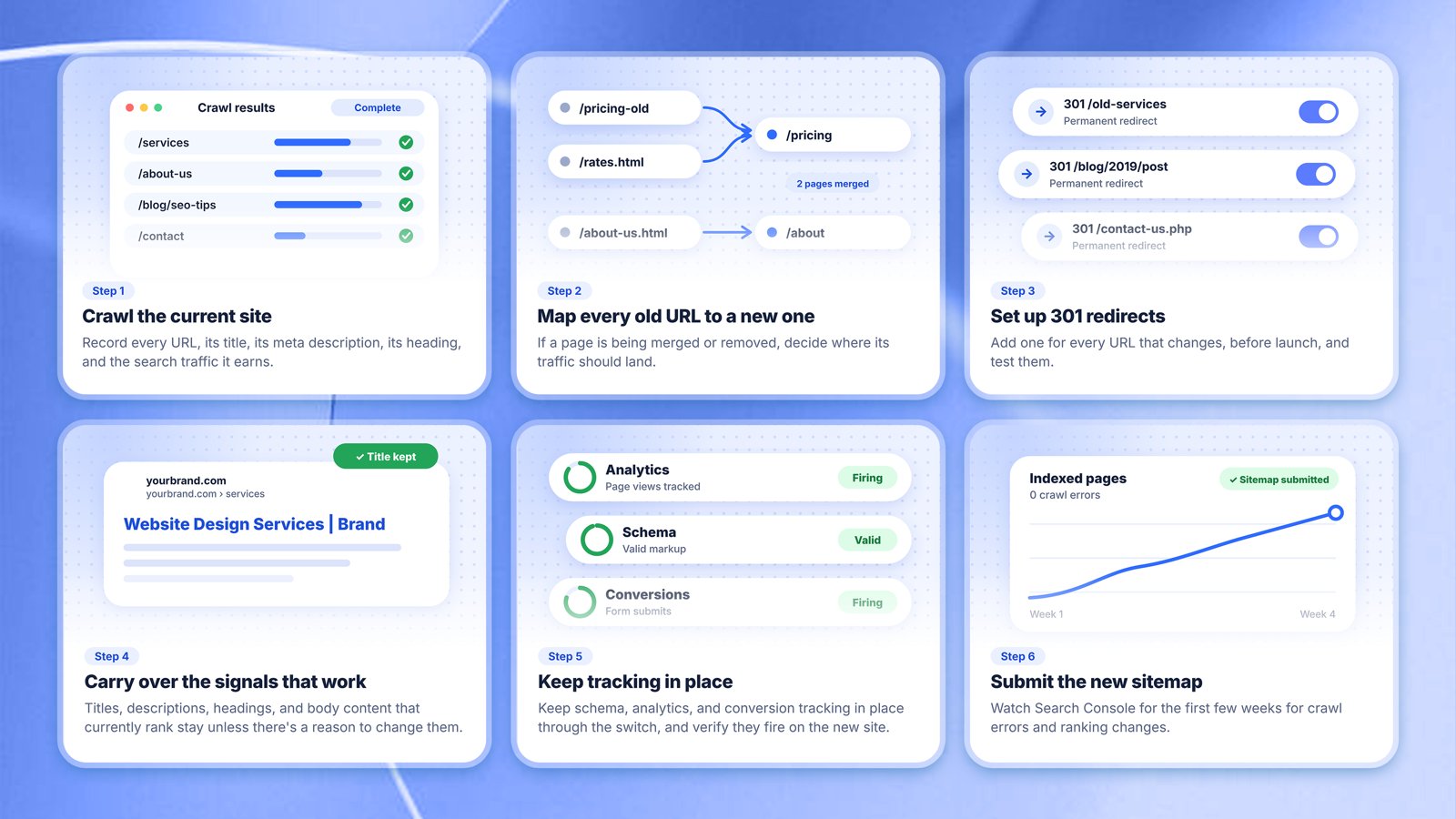
- Crawl the current site and record every URL, its title, its meta description, its heading, and the search traffic it earns.
- Map every old URL to a new one. If a page is being merged or removed, decide where its traffic should land.
- Set up 301 redirects for every URL that changes, before launch, and test them.
- Carry over the signals that work. Titles, descriptions, headings, and body content that currently rank stay unless there’s a reason to change them.
- Keep schema, analytics, and conversion tracking in place through the switch, and verify they fire on the new site.
- Submit the new sitemap and watch Search Console for the first few weeks for crawl errors and ranking changes.
A redesign done this way often lifts rankings, because speed, structure, and mobile experience improve at the same time. A redesign done without it can set a business back a year. If you’re interviewing agencies, our questions to ask a web design agency includes the SEO migration questions that separate the two.
Refresh or Rebuild
A refresh makes sense when the structure is sound and the content is close to right. The site is on a platform you can keep, the pages map to what people search for, and the problem is mostly how it looks and how fast it loads. You keep the URLs, keep the content, and change the surface.
A rebuild makes sense when the structure is the problem. Services without their own pages, locations without their own pages, a builder you can’t edit, tracking that was never installed, or a platform that’s reached the end of its life. In those cases the refresh money is spent twice, once now and again when the structural problems force the rebuild anyway.
If you’re building new rather than replacing, our website cost guide covers that side.
How Long a Redesign Takes
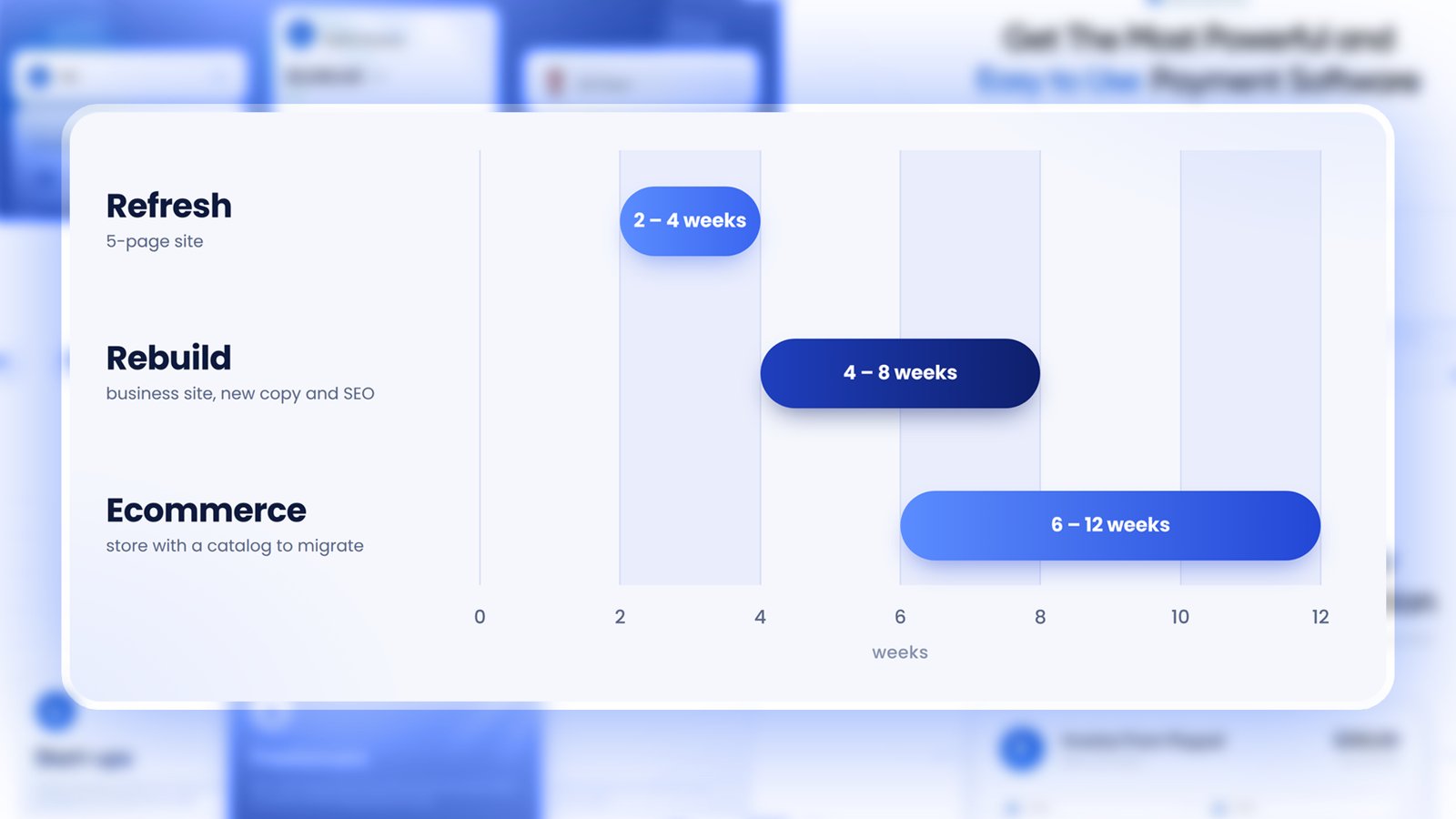
A refresh of a five-page site takes two to four weeks. A rebuild with new copy and SEO work takes four to eight weeks for a business site and six to twelve for a store with a catalog to migrate. Replatforming adds time for migration and testing. The schedule depends as much on how quickly content and approvals come back as on the build itself, so a clear review process on your side shortens it.
After Launch
A redesign resets the clock, and the clock keeps running. Themes and plugins need updating, security needs watching, backups need running, and small content changes keep coming. Published guides suggest budgeting 15 to 20 percent of the build cost each year for upkeep. Our website maintenance plans start at $150 a month and cover updates, security, backups, and speed, with design and development hours at the higher tiers.
Refresh or rebuild? Let’s look at your site together
Book a 30-minute call. We’ll look at the site, the traffic it earns, and what’s holding it back, and tell you which scope fits and what it would cost.
Common questions
How much does it cost to redesign a small business website?
Most small business redesigns run $5,000 to $15,000 in 2026. A focused refresh can be done for $2,500 to $7,500, and a full rebuild with new copy, SEO, and tracking typically runs $7,500 to $25,000. Our five-page redesign is $6,750 with research, copy, graphics, SEO, and tracking included.
How often should a website be redesigned?
Every three to five years is typical, but the calendar matters less than the signs. A site that’s slow on mobile, hard to edit, or no longer converting is ready regardless of its age. A site that’s fast, current, and producing leads doesn’t need a redesign because a date arrived.
Is $1,500 a good price for a website redesign?
For a single landing page, yes. Our one-page build is $1,500 and includes the full research, copy, and tracking stack. For a multi-page redesign, $1,500 usually means a template swap with no copy, SEO, or migration work, and the gaps show up in traffic and leads later.
Will a website redesign hurt my SEO?
It can if URLs change without redirects or content that ranked gets dropped. It usually helps when the redesign includes a URL map, 301 redirects, carried-over titles and content, and a faster, mobile-friendly build. Ask any agency how they handle the migration before you sign.
What’s the difference between a website refresh and a redesign?
A refresh keeps the platform, structure, and URLs and updates the design, copy, and performance. A redesign, or rebuild, restructures the pages and often rewrites the content, and may move the site to a new platform. The refresh costs less and solves fewer problems.
How long does a website redesign take?
Two to four weeks for a small refresh, four to eight weeks for a business site rebuild, and six to twelve weeks for an ecommerce redesign with catalog migration. Content and approval turnaround on your side is usually the biggest variable.

Lily Andrews
Founder of Lotiva. Over a decade helping small businesses grow with SEO, paid ads, and AI search. Connect on LinkedIn.