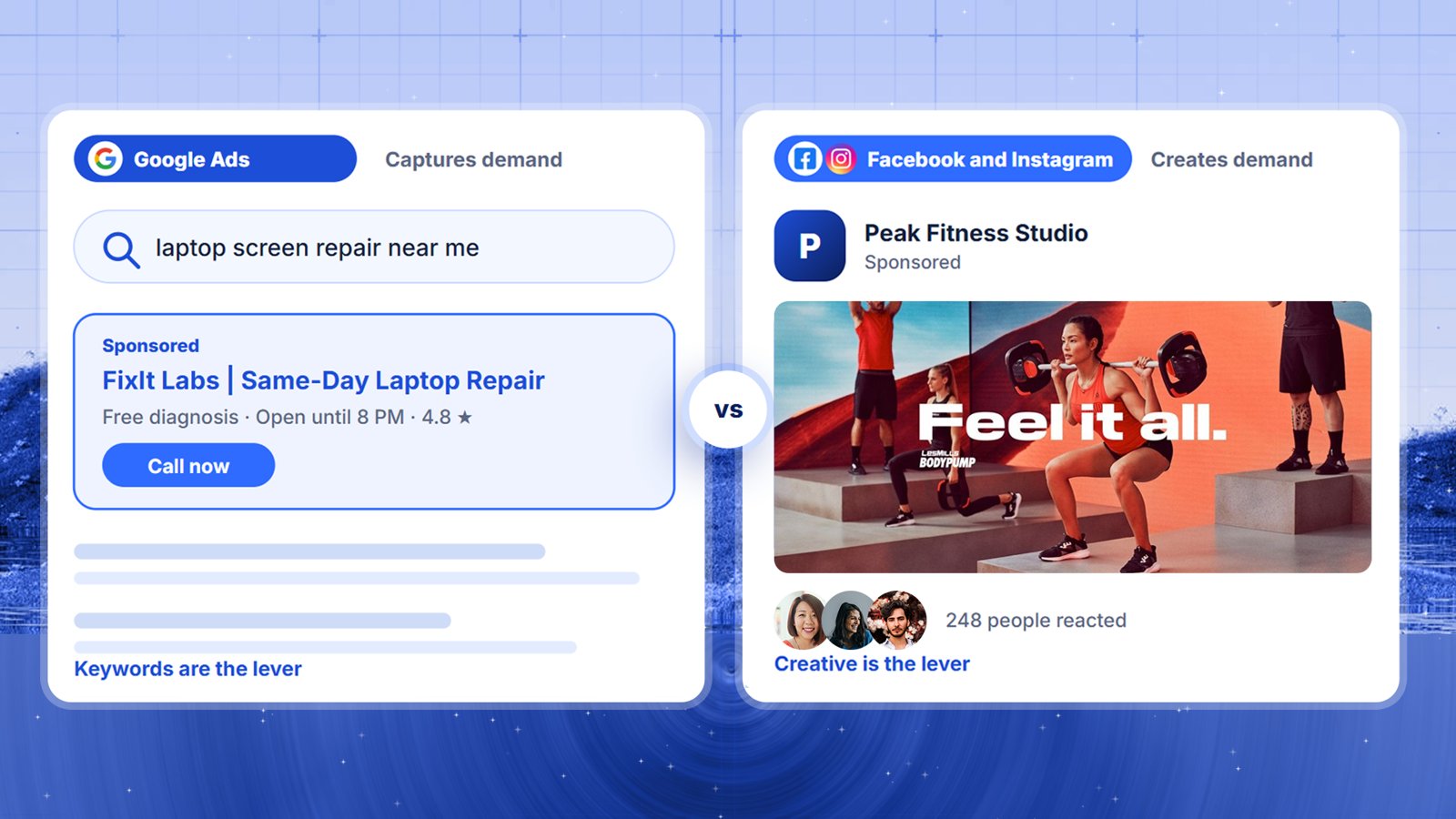
Google Ads reaches people who are searching for what you sell right now. Facebook and Instagram ads reach people who fit the profile of your customer but weren’t looking. That one difference explains almost everything else: Google clicks cost more and convert faster, Meta clicks cost less and need more steps to become a sale, and the right choice depends on whether your customers already know they need you. Most businesses that grow on paid media end up running both, with the split decided by what they sell.
This comparison lays out how each platform finds buyers, what each costs in 2026 with sourced figures, where each one wins, which industries lean which way, and how to divide a budget between them.
How Each Platform Finds Your Buyer
Google Ads captures demand. Someone types “emergency plumber Plano” or “commercial kitchen hood installation” and your ad appears above the results. The person has a need, a word for it, and a decision to make soon. Your job is to be the clearest answer at the moment they ask. Keywords are the lever.
Meta ads create demand. Nobody opens Instagram looking for a new mattress or a med spa. Your ad appears between a friend’s photo and a video, and it has about a second to earn attention from someone who matches your customer’s age, location, interests, and behavior. Your job is to stop the scroll and start a decision that wasn’t on the calendar. Creative is the lever.
That’s also why the two platforms behave differently in reporting. Google traffic tends to convert on the first or second visit. Meta traffic tends to meet you, come back, and then convert, so campaigns built around a single visit look worse than they are.
Cost Side by Side
| Google Ads (Search) | Facebook and Instagram | |
|---|---|---|
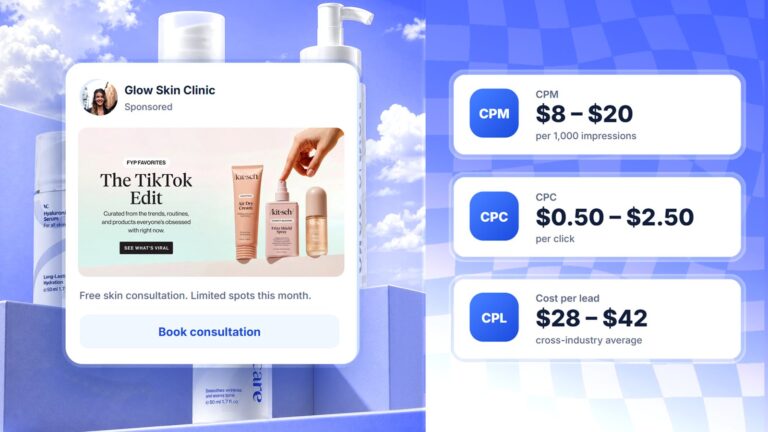
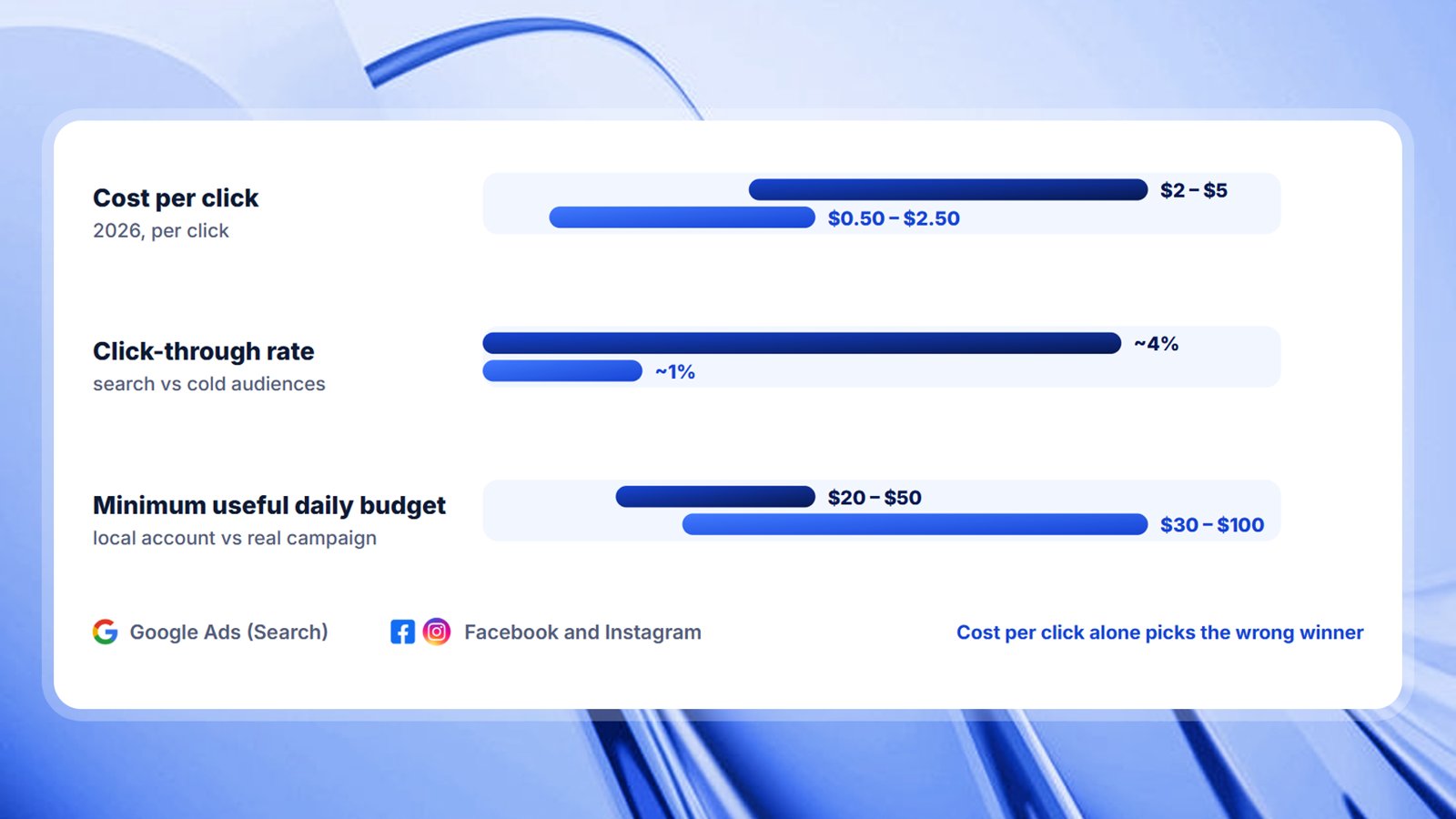
| Typical cost per click | $2 to $5 for most local services; $50 to $150+ in legal, insurance, and finance | $0.50 to $2.50 |
| Cost per 1,000 impressions | Not the pricing model; you pay per click | $8 to $20 |
| Typical click-through rate | Around 4 percent on search ads | Around 1 percent on cold audiences |
| Typical cost per lead | Varies widely by industry; higher per lead, but leads are further along | $28 to $42 average across industries |
| What sets the price | Keyword competition and ad relevance | Audience competition and creative quality |
| Minimum useful budget | $20 to $50 a day for a local account | $30 to $100 a day for a campaign meant to produce customers |
Sources: AgencyAnalytics Google Ads benchmarks (median CPC $2.29, click-through rate 4.26 percent), Sprites.ai October 2026 Facebook cost report, Flow20 July 2026 cost-per-lead analysis, and our own Google Ads cost guide.
The table hides the most important point. A Google click costs more because the person is closer to buying. A Meta click costs less because the platform is finding someone who might buy, and part of the work of getting them there happens after the click, on your page and in your follow-up. Comparing the two on cost per click alone picks the wrong winner.
Where Google Ads Wins
- Urgent and high-intent services. Plumbing, HVAC, locksmiths, urgent care, legal help, towing. When the need is immediate, the search box is where the customer goes, and Google is the only platform standing there.
- Products people search for by name. Replacement parts, specific equipment, branded goods, anything with a model number or a spec. Shopping campaigns put the product and price in front of someone already comparing.
- B2B with a clear search vocabulary. Commercial equipment, industrial services, software categories. Buyers research with precise terms and Google rewards precise answers.
- Measurable intent. Search term reports show the exact words that produced each lead, which makes the account easier to tune and easier to trust.
Our Google Ads management work is built around that intent, and the Google Ads cost guide covers what the management side costs in 2026.
Where Facebook and Instagram Win
- Visual products. Apparel, jewelry, home goods, cosmetics, food. If the product sells on sight, the feed is a better showroom than a text ad.
- Considered purchases with a long decision. Med spas, dental implants, fitness memberships, home remodeling, luxury goods. The customer needs to meet the brand a few times before booking, and Meta is built for repeated, inexpensive contact.
- Offers nobody is searching for yet. A new service, a new category, a local business entering a market. You can’t capture demand that doesn’t exist, so you create it.
- Retargeting. Showing a specific ad to the people who visited a page, watched a video, or abandoned a cart. Meta’s retargeting is cheap and precise, and it often lifts the return on every other channel, including Google.
Our Meta Ads agency work centers on the creative that makes those campaigns run, and the Facebook ads cost guide covers the spend side.
Industries That Lean One Way
| Industry | Usually leads with | Why |
|---|---|---|
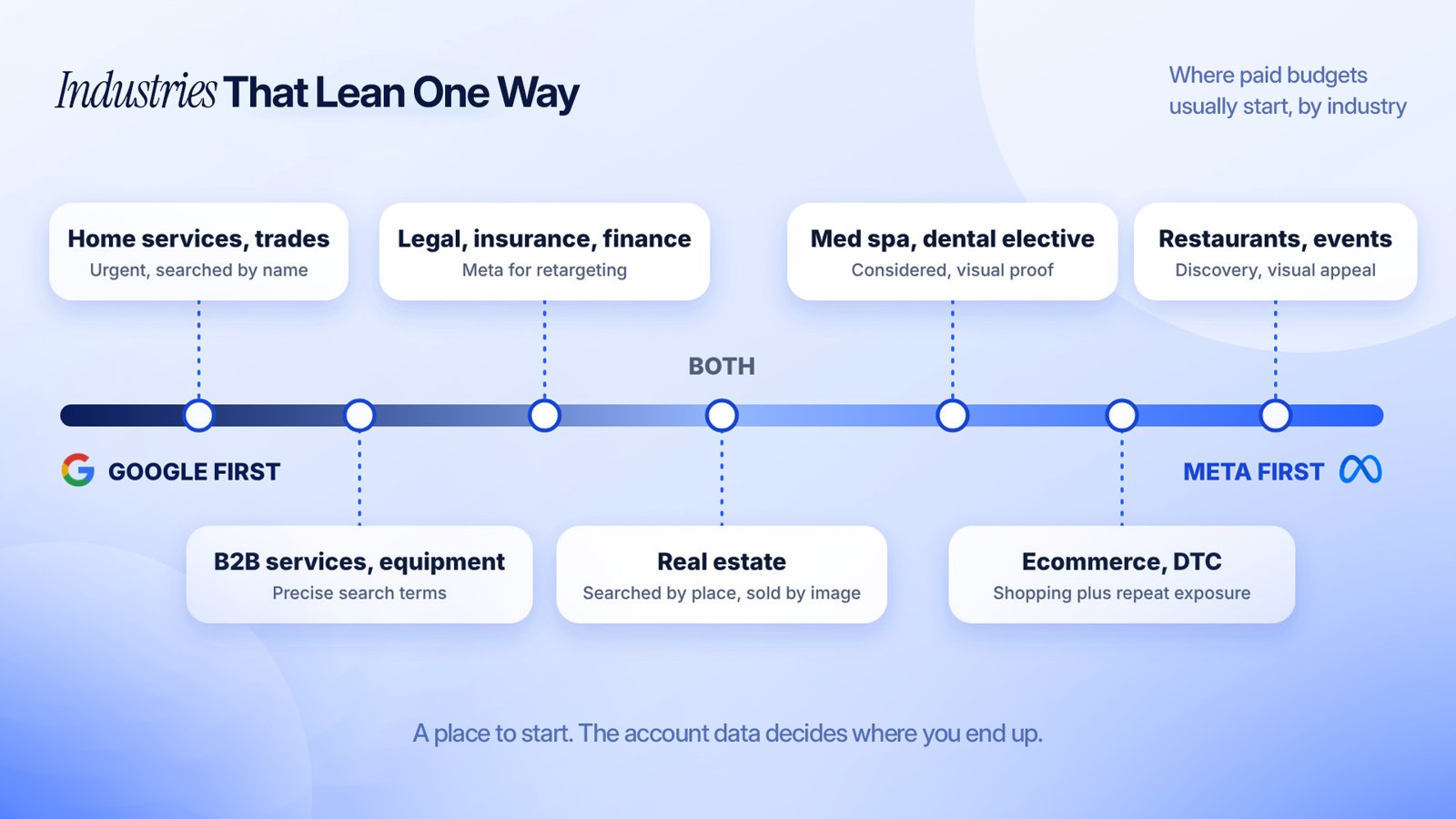
| Home services, trades, repair | Urgent, searched by name, local | |
| Legal, insurance, finance | Google, with Meta for retargeting | Expensive clicks but high-value, high-intent leads |
| Ecommerce, DTC, apparel | Meta, with Google Shopping | Visual products and repeat exposure |
| Med spa, aesthetics, dental elective | Meta first, Google for branded and “near me” | Considered purchase, visual proof |
| Restaurants, hospitality, events | Meta | Discovery and visual appeal; search is mostly branded |
| B2B services and equipment | Google first, LinkedIn or Meta for retargeting | Precise search vocabulary |
| Real estate and new developments | Both | Searched by location, sold by imagery |
None of these are rules. A roofer with a strong before-and-after library can do well on Meta, and a DTC brand with a product people search for by name can lean on Shopping. The table is where to start, and the account data decides where to end up.
Running Both
For most businesses past the first few months of paid media, the question stops being either-or. The platforms do different jobs, and they feed each other.
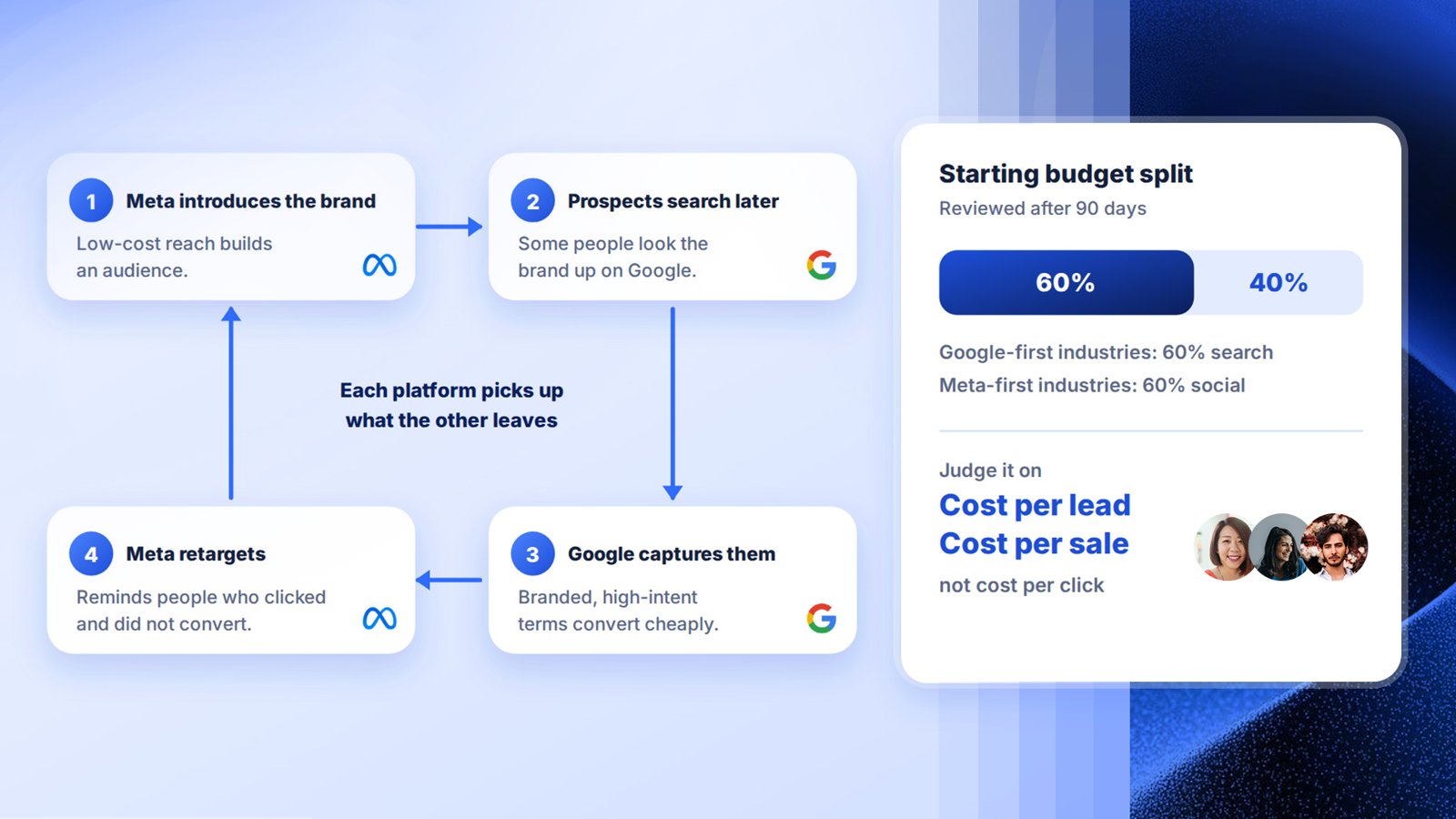
A common structure: Meta introduces the brand and builds an audience at a low cost per impression. Some of those people search later, and Google captures them when they do, often on a branded or high-intent term that converts cheaply. Meanwhile Meta retargets the people who clicked a Google ad and didn’t convert. Each platform picks up what the other leaves.
A reasonable starting split for a business that fits both platforms is 60/40 toward whichever one matches the way its customers buy, reviewed after 90 days against cost per lead and cost per sale rather than cost per click. Businesses in the Google-first column of the table above start 60/40 toward search. Businesses in the Meta-first column start the other way.
If you’re also weighing paid media against organic search, our SEO vs PPC comparison covers how those two channels behave over time.
Management Cost on Each Platform
Our management pricing is the same structure on both platforms, set by monthly ad spend rather than by platform. Starter is $2,000 a month for accounts spending up to $10,000, Growth is $3,000 for up to $20,000, and Premium is $4,000 for up to $30,000. Enterprise accounts above $30,000 a month run a $5,000 base plus a published percentage on the spend above that line. Creative production and landing pages are included on both. Details are on the Google Ads pricing page and the Meta Ads pricing page.
Deciding where the first dollar goes?
Book a 30-minute call. We’ll look at how your customers actually find businesses like yours and tell you which platform to lead with, what it will likely cost, and when to add the second.
Common questions
Which is cheaper, Google Ads or Facebook Ads?
Facebook and Instagram are cheaper per click and per impression. Google is usually cheaper per customer in high-intent categories, because the person searching is closer to buying. Compare the two on cost per lead or cost per sale, not cost per click.
Is $20 a day enough for Google Ads?
For a local service business in a moderately competitive market, $20 to $50 a day is a workable starting point and produces enough clicks to learn from within a month. In legal, insurance, or finance, where a single click can cost $50 or more, $20 a day buys too few clicks to read.
Is $10 a day enough for Facebook Ads?
It’s enough to test whether an audience responds to your creative. It isn’t enough to learn your cost per lead or sale with confidence. Plan $30 to $100 a day for a campaign meant to produce customers.
How much do 1,000 clicks cost on Facebook?
At a typical 2026 cost per click of $0.50 to $2.50, 1,000 clicks cost roughly $500 to $2,500. The number to watch is how many of those clicks become leads or sales, which depends on the offer and the landing page more than on the click price.
Why did Google Ads charge me $500?
Google bills when your spend reaches a payment threshold, which starts at $50 for new accounts and rises to $500 as you pay on time, and again on your monthly billing date for anything left. A $500 charge is ad spend arriving in a batch, not a fee on top of it.
Are Google Ads still worth it in 2026?
Yes, for businesses whose customers search before they buy. Clicks cost more than they did five years ago, and AI Overviews now sit above some results, but search is still where urgent and high-intent buyers go, and a well-managed account is still one of the most measurable ways to reach them.
Should a small business start with Google Ads or Facebook Ads?
Start where your customers already are. If they search for what you do, start with Google. If they need to be introduced to it, start with Meta. Add the second platform once the first one is producing customers at a cost you can read.

Lily Andrews
Founder of Lotiva. Over a decade helping small businesses grow with SEO, paid ads, and AI search. Connect on LinkedIn.