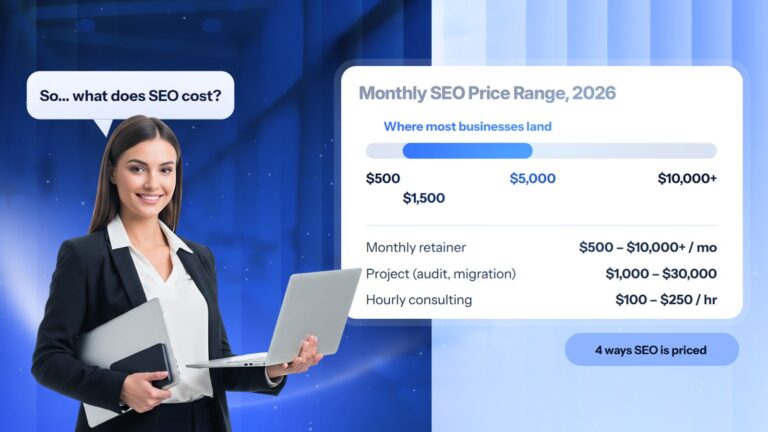
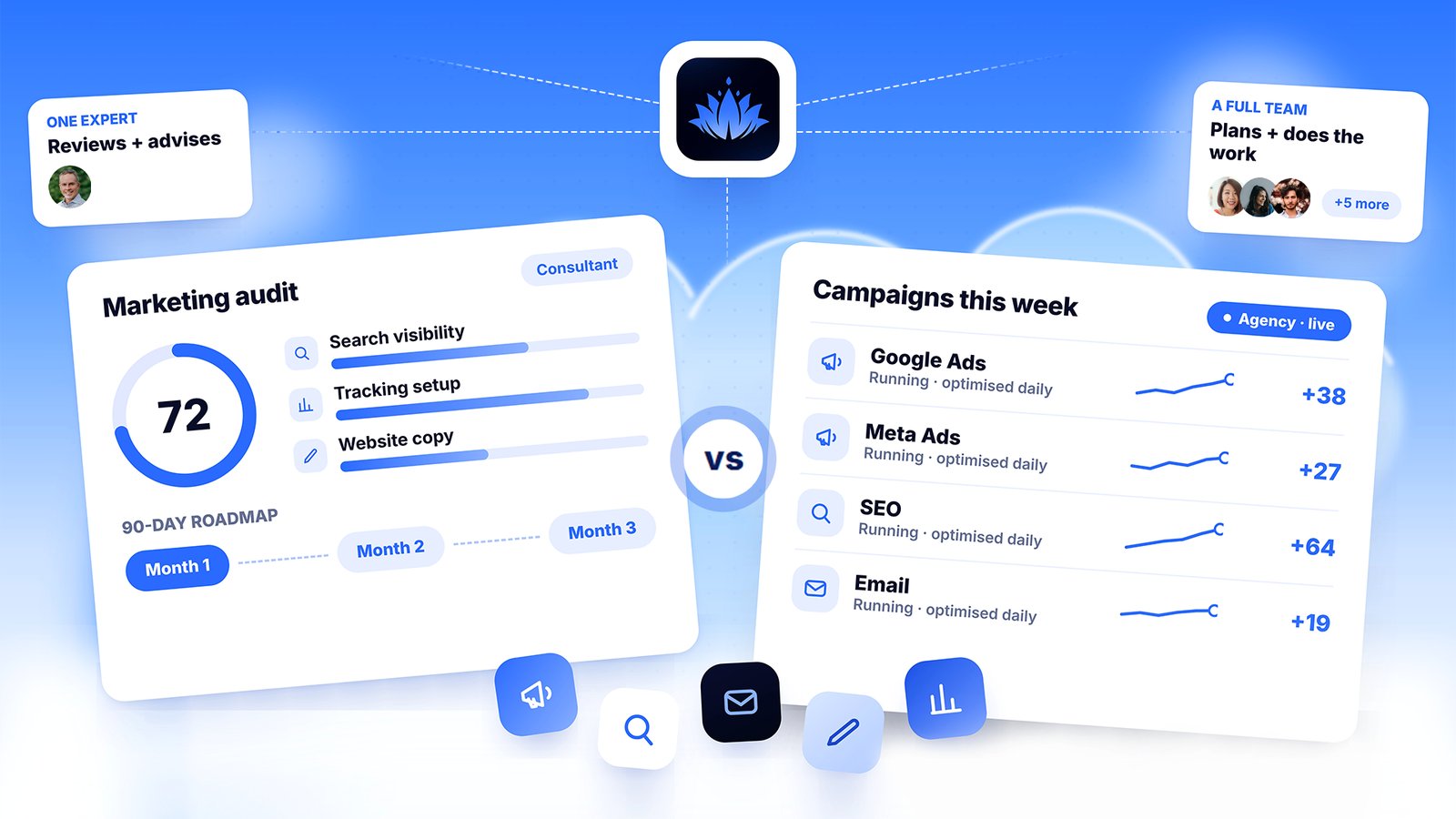
A marketing consultant is an independent specialist who reviews your marketing, sets the strategy, and advises your team, usually for an hourly fee or a monthly retainer. A marketing agency is a team that plans the work and then does it, running the ads, the SEO, the content, and the reporting. Hire a consultant when you have people to carry out a plan and need direction. Hire an agency when you need the plan and the hands to execute it.
The real decision depends on who’s already on your team, how many channels you need running, and what you can spend each month. This guide covers what each one does, what each costs in 2026 with sources, which businesses fit which, and the mix most small businesses settle into.
What a Marketing Consultant Does
A marketing consultant is usually one experienced person, sometimes a small firm, hired to think through your marketing and tell you what to do with it. The work is mostly diagnosis and direction. A consultant spends time learning the business, looks at what’s running today, and hands back a plan with priorities.
Typical consultant work includes:
- Audits. A review of the website, ad accounts, search visibility, and tracking to find what’s working and what isn’t.
- Strategy and positioning. Who the buyer is, what the offer is, which channels make sense, and how the budget should be split across them.
- Plans and roadmaps. A 90-day or 12-month plan with the order to do things in, often handed to an in-house team or a vendor.
- Advisory time. Regular calls with the owner or marketing lead to review results and adjust.
- Vendor oversight. Helping hire and manage agencies, freelancers, or staff, and checking the work they deliver.
Some consultants do hands-on work too, especially specialists in one channel such as SEO or paid search. A digital marketing consultant, for example, may build and run a small Google Ads account directly. But one consultant has a limited number of hours in a week, so once the work spans several channels, execution usually moves to someone else.
A fractional CMO is a senior version of the same role. It’s a part-time marketing executive who owns strategy, budget, and often the team or agencies doing the work, for a set number of days a week.
What a Marketing Agency Does
A marketing agency brings a team instead of one person. There’s usually a strategist or account lead, plus specialists for each channel: paid search, paid social, SEO, content, design, email, and analytics. The agency plans the work, builds the campaigns and assets, runs them week to week, and reports on results.
The difference that matters most is capacity. A consultant tells you the landing page needs rewriting and the ad account needs restructuring. An agency rewrites the page, restructures the account, launches the new campaigns, and watches them daily. When several channels need to work together, such as ads sending traffic to pages that rank and email that follows up on the leads, a team that runs all of them can keep them pointed at the same goal.
Agencies vary widely in scope. Some specialize in one channel, and others run a complete digital marketing program across search, social, content, and email. If you’re comparing agencies, our guide to the best marketing agencies for small business covers what separates them.
Consultant, Fractional CMO, and Agency Rates in 2026
The three options are billed differently, so it helps to see them side by side. These ranges come from 2026 guides published by Talo, Fractionus, GoFractional, Clicksgeek, and Consulting Demand.
| Option | How it’s billed | Typical 2026 range | Source |
|---|---|---|---|
| Freelance marketing consultant | Hourly | $65 to $150 an hour, with a national average around $75 | Talo |
| Senior or executive consultant | Hourly | $125 to $350+ an hour | Talo |
| Consultant retainer, small business | Monthly | $1,500 to $5,000 a month | Talo |
| Consultant retainer, mid-size and enterprise | Monthly | $5,000 to $15,000+ a month | Talo |
| Consultant project, such as an audit or small campaign | Per project | $2,500 to $10,000 | Talo |
| Strategy consulting firm | Hourly | $100 to $149 an hour (Clutch US average) | Consulting Demand |
| Fractional CMO | Monthly retainer | $8,000 to $22,000 a month (Fractionus); $4,000 to $20,000 a month (GoFractional) | Fractionus, GoFractional |
| Fractional CMO | Hourly | $200 to $450 an hour (Fractionus); $150 to $500 an hour (GoFractional) | Fractionus, GoFractional |
| Agency, paid ads management | Monthly | $1,500 to $5,000 a month for management, separate from ad spend | Clicksgeek |
| Agency, local SEO | Monthly | $2,000 to $7,500 a month | Clicksgeek |
| Agency, multi-channel retainer | Monthly | Starts around $5,000 a month and can pass $15,000 | Clicksgeek |
Two things help when reading the table. First, the consultant figures mostly cover advice and planning, and the work itself still has to be done by someone. A $3,000 consultant retainer plus the people or vendors who carry out the plan is a different budget from a $3,000 agency retainer that includes the execution. Second, agency fees for paid media don’t include the ad spend itself, and some agencies price larger accounts partly on a percentage of spend.
For context on the senior end, Fractionus cites Built In’s 2026 average US CMO salary of $225,908 and puts the full cost of a full-time CMO at $270,000 to $320,000 or more once benefits, payroll taxes, and recruiting are included. For a closer look at one channel, our SEO cost guide breaks down what search work runs by scope.
Matching the Hire to the Business
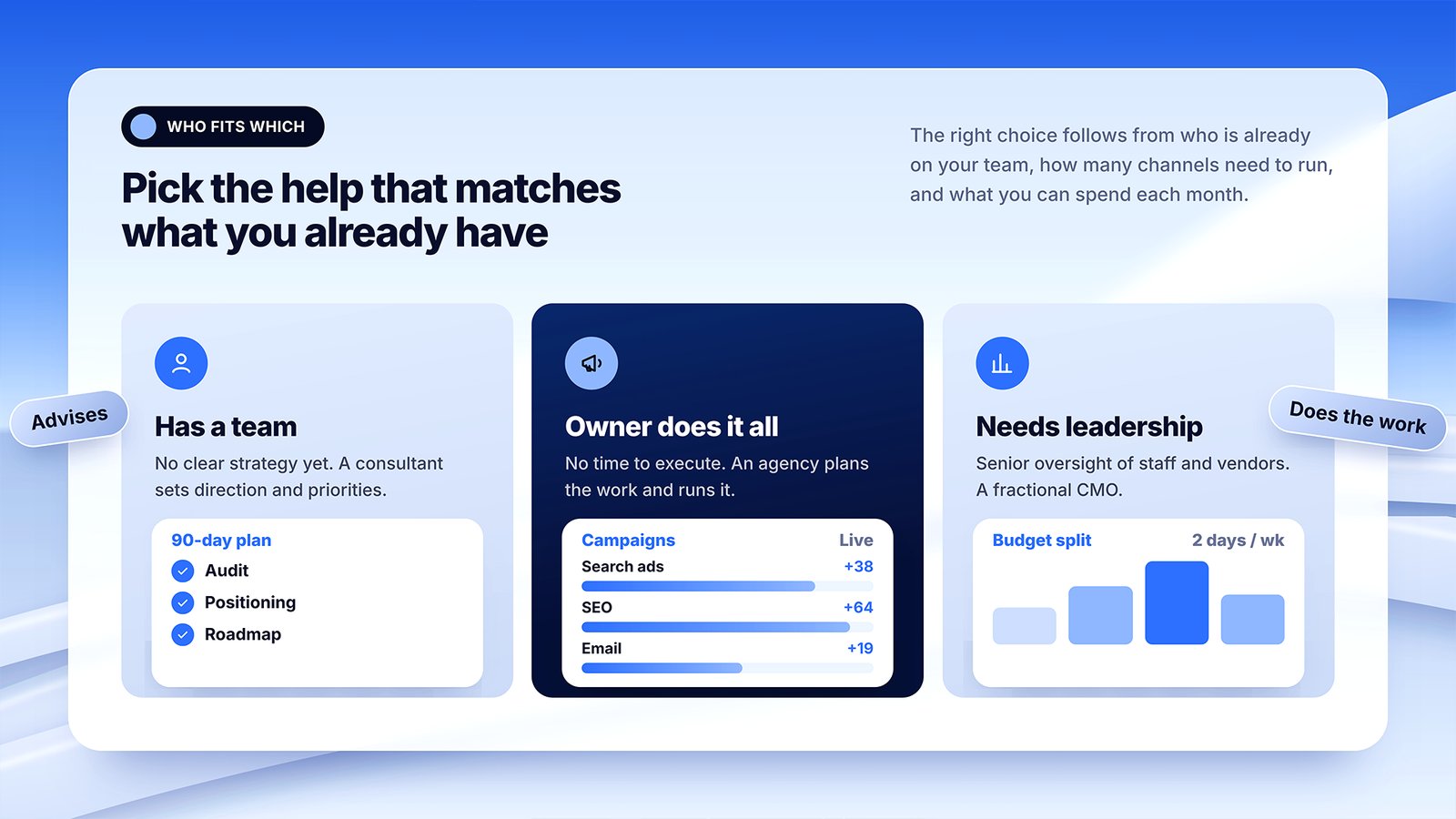
The right choice follows from what the business already has in place. These are the patterns that usually decide it.
| Situation | Usually the better fit |
|---|---|
| In-house marketer or team in place, but no clear strategy | Consultant or fractional CMO |
| Owner handling marketing alone, with no time to execute | Agency |
| One channel needs fixing, such as an underperforming ad account | Specialist consultant or a single-channel agency |
| Several channels need to run together every week | Agency |
| Larger company needing senior leadership over staff and vendors | Fractional CMO |
| Limited budget and a one-time question to answer | Consultant on a project or hourly basis |
A consultant fits when someone on your side can carry out the plan. That could be a marketing coordinator, a sales team that handles its own outreach, or an owner with time to run a few campaigns. It also fits when the question is narrow, such as whether to enter a new market or why leads dropped last quarter.
An agency fits when the business needs output as well as direction. If nobody on staff has the hours or the skills to build campaigns, write pages, manage bids, and set up tracking, a plan on its own won’t move much. Agencies also fit when several channels have to work together, because one team can coordinate them.
In-house marketing vs agency is a related decision. A full-time hire knows the business deeply and is available every day, but one person rarely covers every channel well, and building a full team is a large fixed cost. Many companies keep one in-house marketer as the owner of the brand and the calendar and use an agency for the specialist channels.
Freelancer vs agency comes down to scope and continuity. A freelancer can be a strong, affordable choice for a single task, such as a set of blog posts or a logo. When the work spans several channels or needs coverage through vacations and turnover, an agency’s team gives you that continuity.
If you’re still working out which channels matter most, our small business marketing strategy guide is a good place to start before hiring anyone.
The Hybrid Most Small Businesses End Up With
In practice, many small and mid-size businesses don’t pick just one. They combine strategy and execution in a way that fits the size of the company, and the mix changes as the business grows. Four combinations come up again and again.
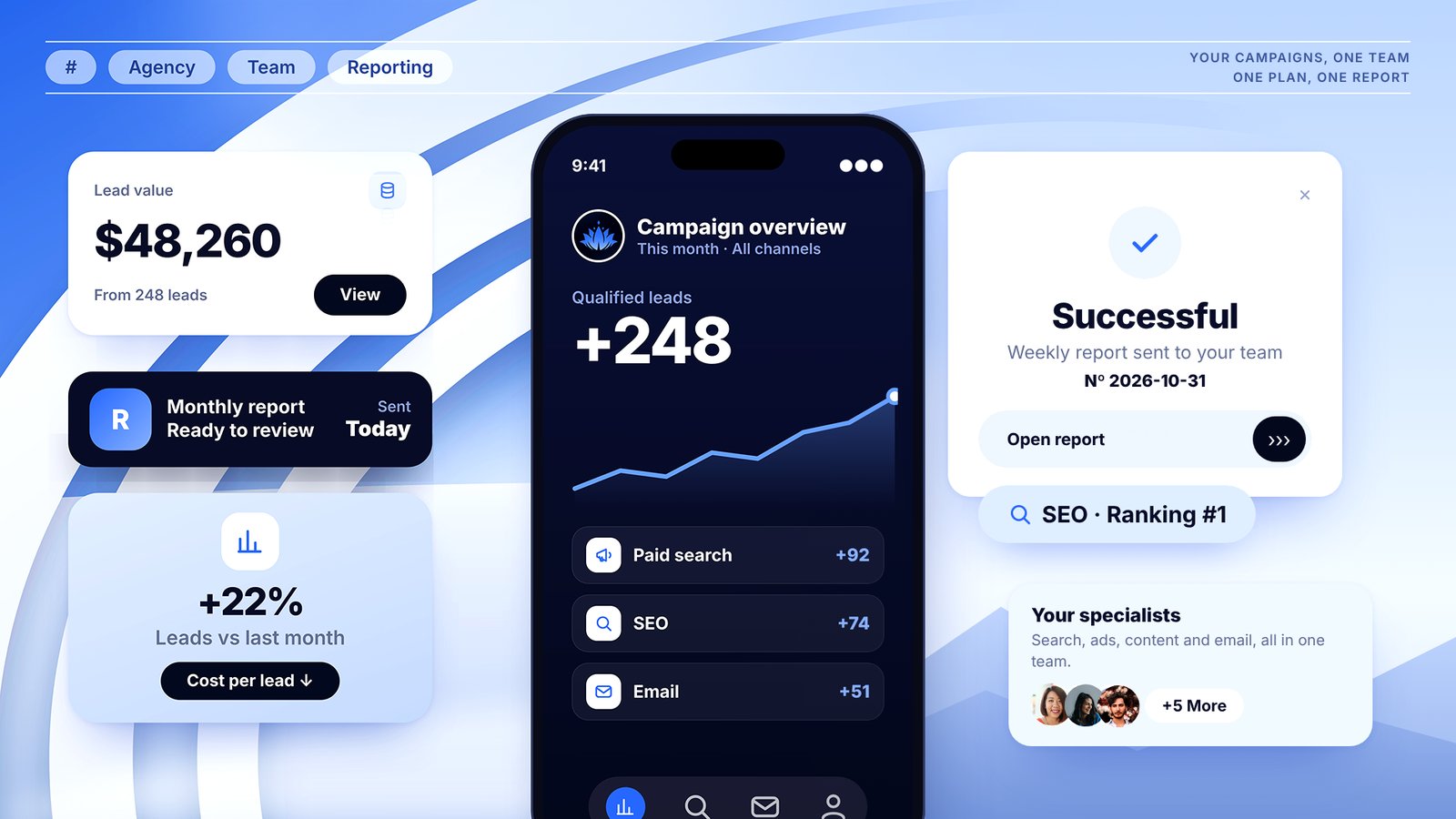
- An agency with a strategist built in. For most small businesses, this is the simplest setup. A senior strategist on the agency side does the consultant’s job, setting priorities and reviewing results, and the agency’s team carries out the work. You get one plan, one point of contact, and one report.
- A consultant plus an agency. A consultant or fractional CMO sets direction and holds the agency accountable. This works well for companies with larger budgets and several vendors to coordinate.
- An in-house marketer plus an agency. An employee owns the brand, the content calendar, and internal communication, while the agency runs paid media, SEO, and the technical pieces.
- A consultant first, then an agency. A business hires a consultant for an audit and a plan, then brings in an agency to carry it out. It’s a sensible order when the business isn’t sure yet what it needs.
Someone has to own the strategy and someone has to do the work. When those are two different teams, agree up front on who makes the final call on budget and priorities, so the plan keeps moving between them.
Lotiva works both ways. Every marketing plan comes with a senior strategist and a monthly business review built in, so the consultant’s job is already covered when we run the work. We also take consulting engagements on their own, for businesses with a team in place that needs direction more than hands.
Questions to Ask Before You Hire Either One
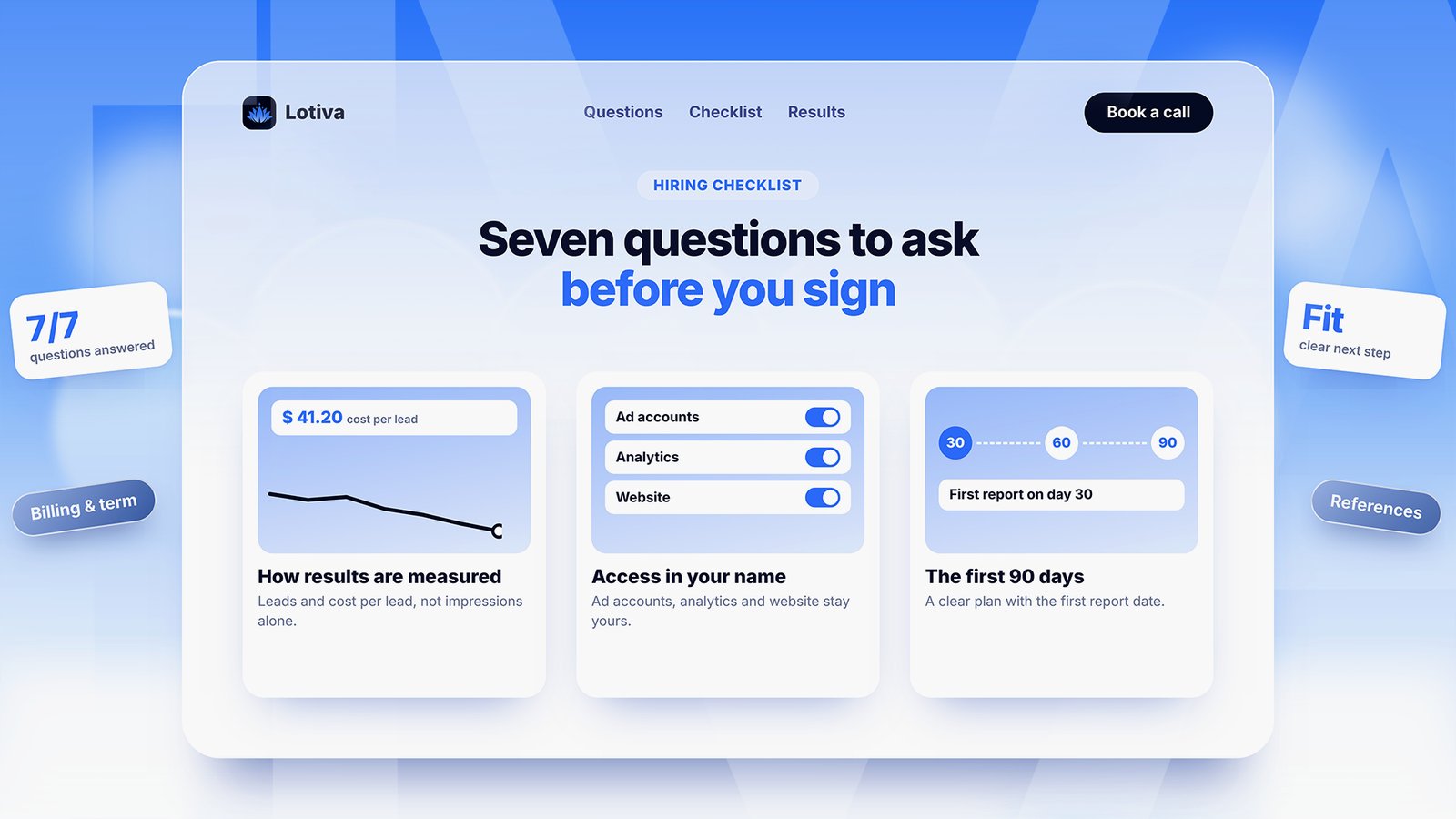
The same short list of questions works for a consultant or an agency, and the answers show quickly whether the fit is right.
- Who will do the work day to day? For a consultant, ask whether they execute or only advise. For an agency, ask who’s on your account and how senior they are.
- What will the first 90 days look like? A clear answer names the audit, the first priorities, and when you’ll see the first report.
- How do you measure results? Look for leads, sales, and cost per lead, tied to tracking you can see, rather than impressions alone.
- What access will I have? Ask whether ad accounts, analytics, and the website are set up in your name and whether you’ll have login access.
- How is the engagement billed and structured? Hourly, monthly, or per project, and the length of the term. Get it in writing.
- How often is the strategy reviewed? Markets shift, so ask how often the plan gets revisited and how changes are handled.
- Can I speak with a current client? A reference in a similar business tells you more than a case study page.
If a website is part of the work, our questions to ask a web design agency checklist adds the build and SEO questions that matter for that piece.
Deciding between a consultant, an agency, or a mix of the two?
Book a free 30-minute call. We’ll look at what you have in place and which channels matter for your buyers, then recommend consulting, a full plan, or a mix. We offer both, so the recommendation follows what you already have.
Common questions
What does a marketing consultant do for a small business?
A marketing consultant reviews how the business markets itself today, finds the gaps, and sets a plan with clear priorities. That usually means an audit of the website, ads, and tracking, a strategy for which channels to use and how to split the budget, and regular check-ins to adjust. Some consultants also do hands-on work in one channel.
How do marketing consultants charge?
Consultants bill hourly, by monthly retainer, or per project. Talo’s 2026 guide puts freelance marketing consultants at $65 to $150 an hour, small business retainers at $1,500 to $5,000 a month, and projects such as an audit at $2,500 to $10,000. Senior consultants charge $125 to $350 an hour or more.
Is a fractional CMO the same as a marketing consultant?
They overlap, but a fractional CMO is a senior, ongoing leadership role. A consultant often advises on a defined question or project, while a fractional CMO owns the marketing strategy, budget, and team or vendors for a set number of days each week. Fractionus puts US fractional CMO retainers at $8,000 to $22,000 a month in 2026.
Is it better to hire in-house or use a marketing agency?
It depends on scope. An in-house marketer knows the business well and is always available, but one person rarely covers every channel. An agency brings specialists for each channel without the cost of hiring them all. Many businesses use both, with an employee owning the brand and calendar and an agency running paid media and SEO.
Should a small business hire a freelancer or an agency?
A freelancer suits a single, well-defined task like a batch of blog posts or a logo. An agency suits ongoing work across several channels, where coordination and continuity matter. If the work needs to keep running through vacations and staff changes, an agency’s team covers that.
Does Lotiva offer consulting as well as agency services?
Yes. Lotiva works as a consultant or as an agency depending on what the business already has in place. Consulting covers audits, strategy, 90-day plans, and advisory time for owners and in-house teams who will carry out the work themselves. Agency plans add the execution across SEO, paid ads, content, email, and social, with a senior strategist and a monthly business review included. The strategy call is where we work out which one fits.
What does a marketing agency cost per month at Lotiva?
Every monthly Lotiva service starts at $2,000 a month, whether it’s Google Ads, Meta Ads, SEO, email and SMS, social, or creative. Plans run on 3, 6, or 12 month terms, and 6 and 12 month terms take a discount off the first 3 months. Large ad budgets are structured individually, and we’ll walk you through it on a call. The full breakdown is on our pricing page.

Lily Andrews
Founder of Lotiva. Over a decade helping small businesses grow with SEO, paid ads, and AI search. Connect on LinkedIn.