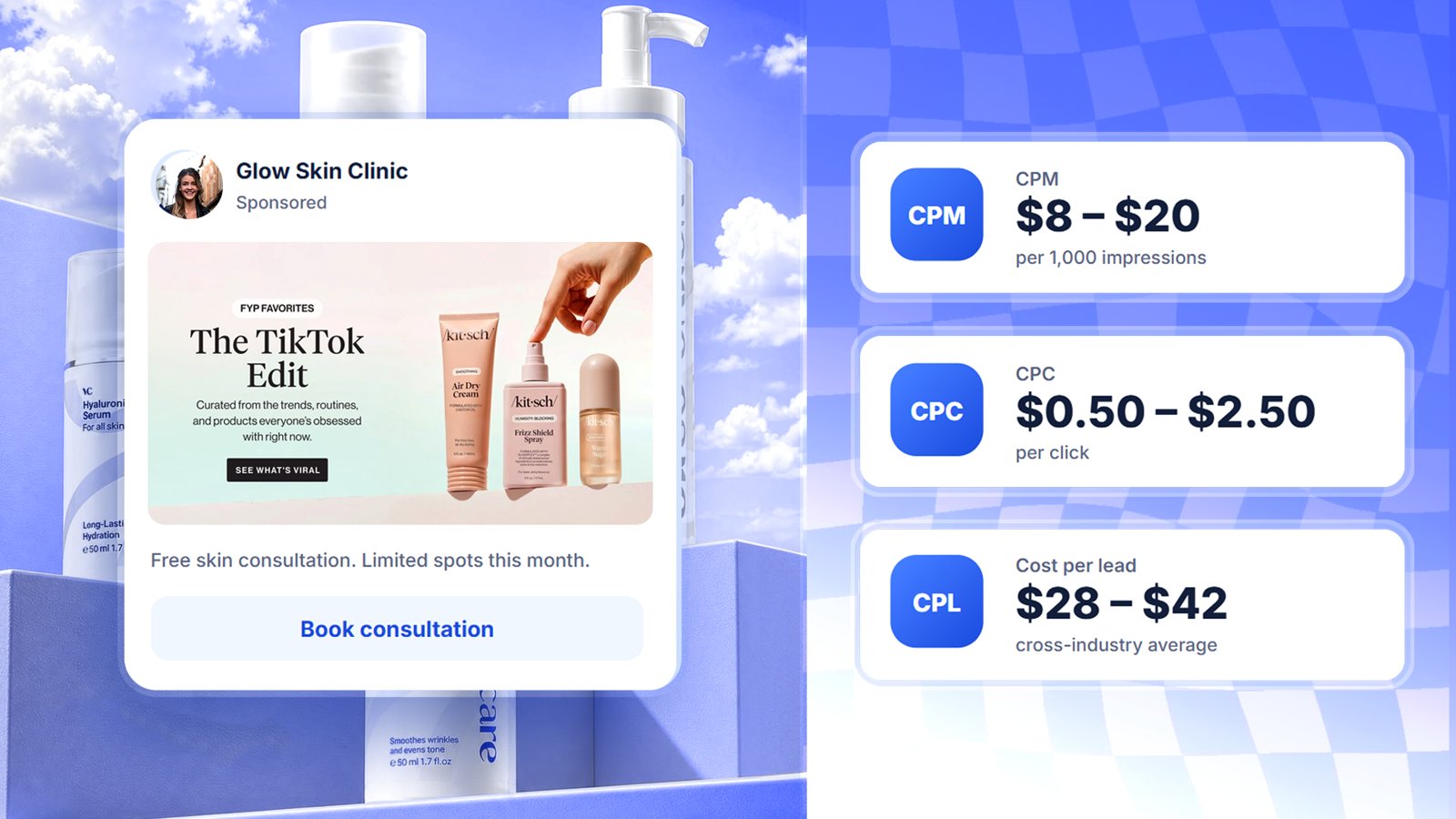
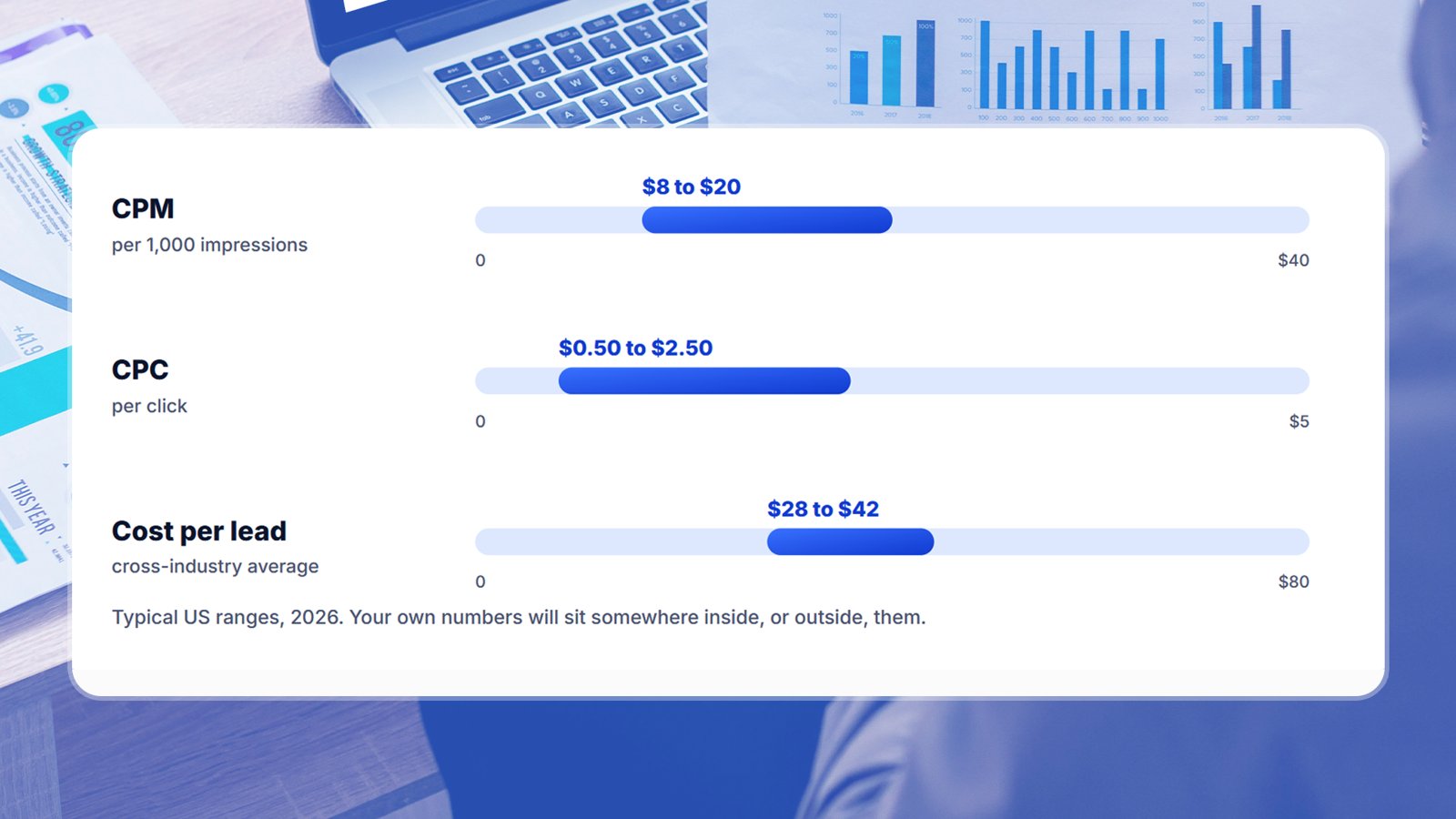
Facebook and Instagram ads cost whatever you tell Meta to spend. There’s no minimum beyond about a dollar a day per ad set, so the real question is what that spend buys. In 2026, typical US campaigns pay $8 to $20 for every thousand impressions and $0.50 to $2.50 per click, according to benchmarks published this month, and the average cost per lead across industries sits around $28 to $42. A small business running a sensible first campaign usually spends $1,000 to $3,000 a month on ads, and if an agency runs the account, management is a separate fee on top.
This guide breaks the cost into its parts: what Meta charges per result, what changes that number, how ad spend and management fees differ, and what a realistic starting budget looks like for a business that wants real data rather than a test that proves nothing.
The Numbers Meta Charges Against
Meta runs an auction. You set a budget and a goal, and the platform charges you based on how many advertisers are competing for the people you want to reach and how well your ad holds their attention. Four figures matter.
| Metric | What it measures | Typical 2026 range (US) |
|---|---|---|
| CPM | Cost per 1,000 impressions | $8 to $20 |
| CPC | Cost per link click | $0.50 to $2.50 |
| CPL | Cost per lead (form fill, call, message) | $28 to $42 average across industries |
| CPA | Cost per purchase or booked appointment | Varies widely by price point and industry |
Benchmarks drawn from Sprites.ai’s October 2026 cost report and Flow20’s July 2026 cost-per-lead analysis.
CPM is the price of attention and it rises with competition, so November and December cost more than February. CPC depends on CPM and on how many of the people who see the ad decide to click, which is mostly a creative question. Cost per lead and cost per acquisition are the figures a business should actually manage to, because they tie spend to something that pays the bills.
What Moves the Price
Two businesses can run the same budget and pay very different prices per result. These are the levers.
- Creative. Meta rewards ads people stop for with cheaper reach. A tired ad that has run for nine weeks costs more every week it stays live, because the same people keep seeing it and keep scrolling past.
- Audience and competition. Reaching homeowners in Dallas during a roofing season costs more than reaching the same people in February. Finance, insurance, legal, and real estate pay the highest CPMs because the customer is worth more to every advertiser bidding.
- Objective. A campaign optimized for purchases or leads pays more per impression than one optimized for traffic, because Meta is finding people likely to act rather than people likely to click.
- Placement. Reels and Stories inventory often costs less per impression than Feed, though it converts differently. Letting Meta place across all of them usually lowers the blended cost.
- Tracking quality. When the Conversions API and pixel report every sale back to Meta, the algorithm learns faster and costs fall. When tracking is incomplete, the platform optimizes with less information and the price per result climbs.
- Landing page. A click that lands on a slow page or a weak offer is a click paid for with nothing to show. The ad takes the blame for a conversion problem that lives on the website.
Ad Spend and Management Fees Are Two Different Numbers
The figures above are what Meta charges. If someone manages the account for you, that’s a second cost, and the two are often blurred in quotes.
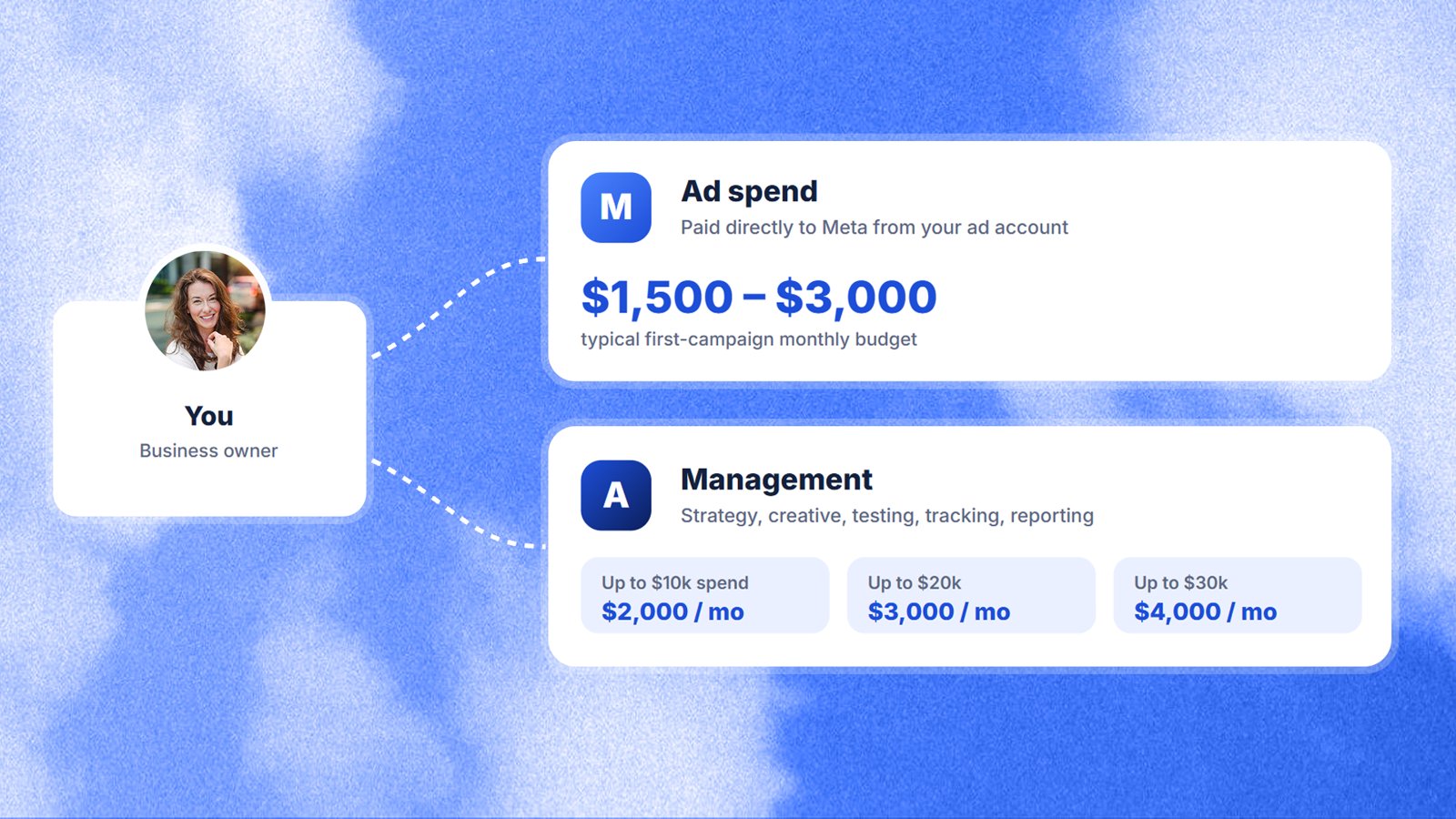
Ad spend goes to Meta. It’s the budget your ads consume, and you pay it directly from your ad account whether you run the campaigns yourself or an agency does.
Management pays for the work: strategy, creative production, copywriting, audience building, testing, tracking setup, and reporting. Agencies price it one of three ways. A flat monthly fee tied to a spend tier. A percentage of ad spend, commonly 10 to 20 percent. Or an hourly or project rate for setup-only work.
Our Meta Ads plans use a flat fee by spend tier: $2,000 a month for accounts spending up to $10,000, $3,000 for up to $20,000, and $4,000 for up to $30,000. Above that, Enterprise accounts run a $5,000 base plus a published percentage on spend over $30,000. Every tier includes creative production and the landing page, which is a cost many quotes leave out. The full breakdown is on the Meta Ads management pricing page.
A Realistic Starting Budget
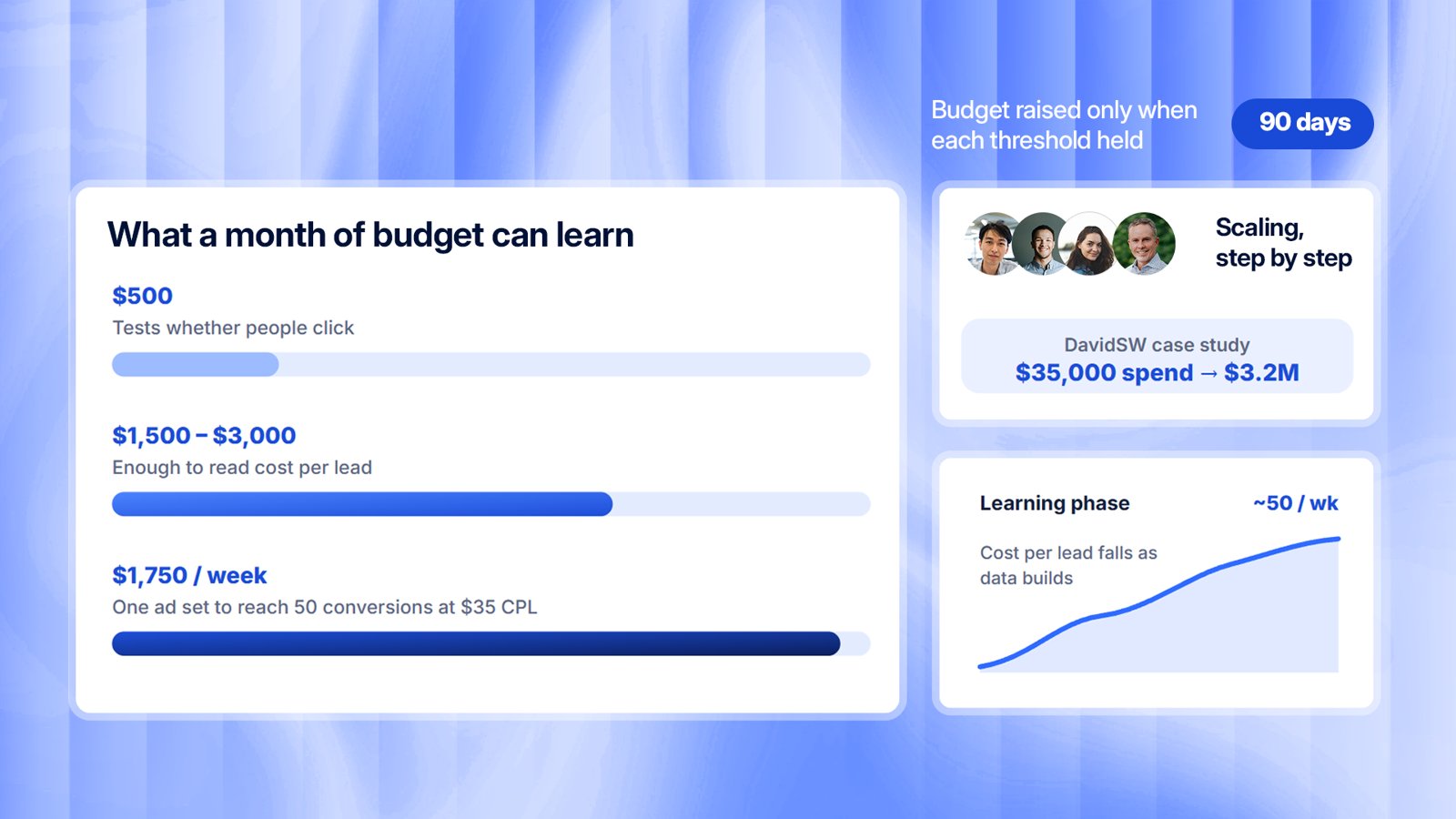
The most common question in forums is whether $500 is enough. The answer depends on what you need to learn. At $8 to $20 per thousand impressions, $500 buys roughly 25,000 to 60,000 impressions, which is enough to see whether people click but not enough to produce a reliable read on cost per lead or cost per sale. Meta’s learning phase needs about 50 conversion events per ad set per week to stabilize. At a $35 cost per lead, that’s about $1,750 a week for a single ad set.
In practice, a small business testing lead generation does well to plan $1,500 to $3,000 a month in ad spend for the first 60 to 90 days. That covers two or three ad sets, several creative variations, and enough conversions to know what’s working before scaling. Ecommerce brands with a lower price point can often start lower and learn faster because purchases come in higher volume. High-ticket businesses need more, because each conversion is rarer and costs more to find.
Scaling is a different exercise. Our DavidSW case study shows what disciplined scaling looked like for a luxury watch retailer: $35,000 in ad spend over 90 days returned $3.2 million, with budget raised only when the numbers at each threshold supported it.
Reading Your Own Results
Published averages tell you whether a quote is reasonable. They don’t tell you whether your campaign is healthy. Four checks do.
- Cost per result against your margin. A $40 lead is cheap for a roofer and expensive for a $20 product. Work backward from what a customer is worth to find the cost per lead or sale you can afford.
- Frequency. When the same person has seen your ad more than three or four times in a week, costs are about to climb. Fresh creative resets it.
- Click-through rate. Around one percent is typical for a cold audience. Well below that usually means the creative or the audience is off, not the budget.
- Landing page conversion rate. If clicks are cheap and leads are expensive, the problem is after the click.
Our Facebook ads management guide walks through the account structure behind those numbers. If you’re weighing paid social against paid search, our Google Ads vs Facebook Ads comparison covers where each platform wins, and the Google Ads management cost guide covers the other side in the same format.
Want a read on what your market costs before you spend?
Book a 30-minute call. We’ll look at your offer, your audience, and your tracking, and tell you what a first 90 days would reasonably cost and return.
Common questions
How much do Facebook ads cost per day?
There’s no required daily minimum beyond about a dollar per ad set, so you can run ads for $5 a day. A budget that small rarely produces enough conversions to learn from. Most small businesses running a real campaign spend $30 to $100 a day.
Is $500 enough for Facebook ads?
It’s enough to test whether an audience clicks, and not enough to learn your cost per lead or sale with confidence. Treat $500 as a creative and audience test, and plan $1,500 to $3,000 a month for a campaign meant to produce customers.
How many views do you get for $1 on Facebook?
At a typical 2026 CPM of $8 to $20, a dollar buys roughly 50 to 125 impressions. Impressions aren’t views in the sense of someone watching a video, and they aren’t the metric to manage to. Cost per lead or sale is.
Why does Facebook charge me $25 at a time?
Meta bills when your spend reaches a billing threshold, which starts low for new accounts and rises as you pay on time, and again at the end of each month for whatever’s left. The $25 charges are your ad spend arriving in installments, not an extra fee.
Is it worth paying for ads on Facebook in 2026?
For businesses with a clear offer and a page built to convert, yes. Meta remains one of the cheapest ways to put a message in front of a defined audience, and it works for both ecommerce and lead generation. It works poorly when the creative is weak, the tracking is incomplete, or the landing page can’t close.
How much does Meta Ads management cost?
Agencies charge a flat monthly fee, a percentage of spend, or an hourly rate. Our plans run $2,000 to $4,000 a month by spend tier with creative and the landing page included, and Enterprise accounts above $30,000 a month in spend are structured individually. We’ll walk you through it on a call.
Do Instagram ads cost the same as Facebook ads?
They run through the same auction and the same Ads Manager, and costs are usually close. Instagram placements sometimes carry a higher CPM and a different click behavior, so most accounts run both and let the platform place by performance.

Lily Andrews
Founder of Lotiva. Over a decade helping small businesses grow with SEO, paid ads, and AI search. Connect on LinkedIn.