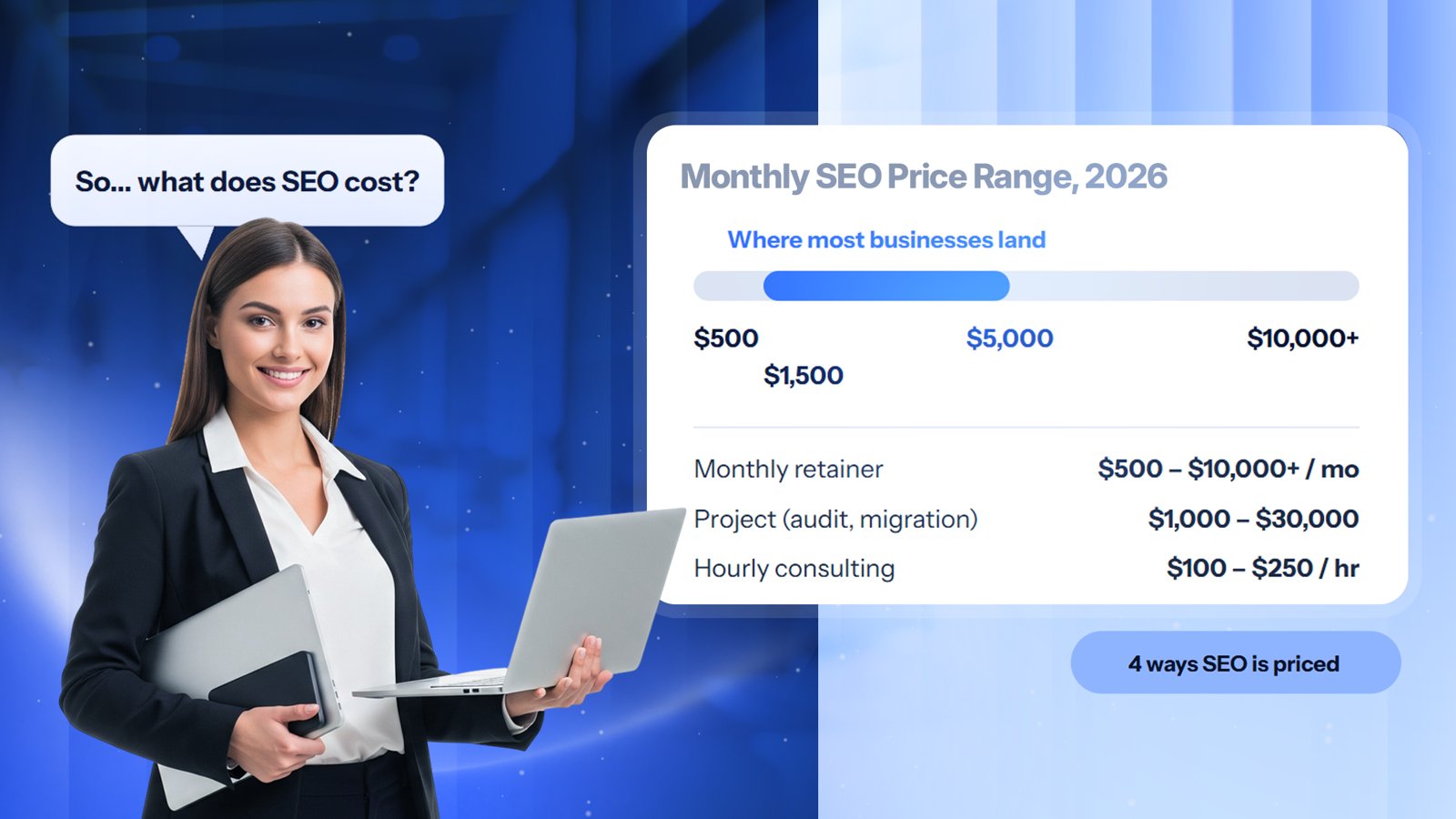
Most small and mid-size businesses pay between $1,500 and $5,000 a month for SEO in 2026. Published pricing guides this year put the full range anywhere from $500 a month for a light local plan to $10,000 and up for enterprise work, with one-time projects like audits and migrations running $1,000 to $30,000. Hourly consulting sits between $100 and $250 an hour. The spread is wide because “SEO” covers everything from a quarterly check-in to a full content, link, and technical program run by a senior team.
This guide walks through the four ways SEO is priced, what you should expect at each price band, what moves the number up or down, and how to read a quote so you know what the money buys. Where we quote our own plans, the figures match our pricing page.
SEO Pricing Models
Almost every SEO quote you’ll see fits one of four models. The model matters as much as the number, because it decides how the price behaves as the work grows.
| Model | How it works | Typical 2026 range | Best fit |
|---|---|---|---|
| Monthly retainer | A fixed fee for ongoing work: technical fixes, content, links, reporting | $500 to $10,000+ a month | Businesses that want steady growth and a team that owns the results |
| Project | One price for a defined scope, like an audit, a migration, or a redesign | $1,000 to $30,000 | A specific problem with a clear finish line |
| Hourly | Pay for time, usually consulting, audits, or training | $100 to $250 an hour | Teams with in-house staff who can do the work |
| Performance-based | Pay when rankings or leads hit a target | Varies, often a share of results | Rare in practice, and worth reading closely |
Ranges above are drawn from 2026 pricing guides published by The Frank Agency, Shopify, and Abstrakt Marketing Group.
The monthly retainer is the most common model and the one most small businesses end up with, because SEO is ongoing work. Pages need updating, competitors keep publishing, Google keeps changing, and AI answers keep pulling from whoever explains a topic best. A retainer puts a team on that every month. Project pricing suits a one-time job. Hourly suits a company that already has someone to do the work and needs direction. Performance pricing sounds appealing and is rare for a reason: agencies that offer it usually control the keyword list, and the easiest keywords to hit aren’t always the ones that bring in customers.
Price Bands and What They Include
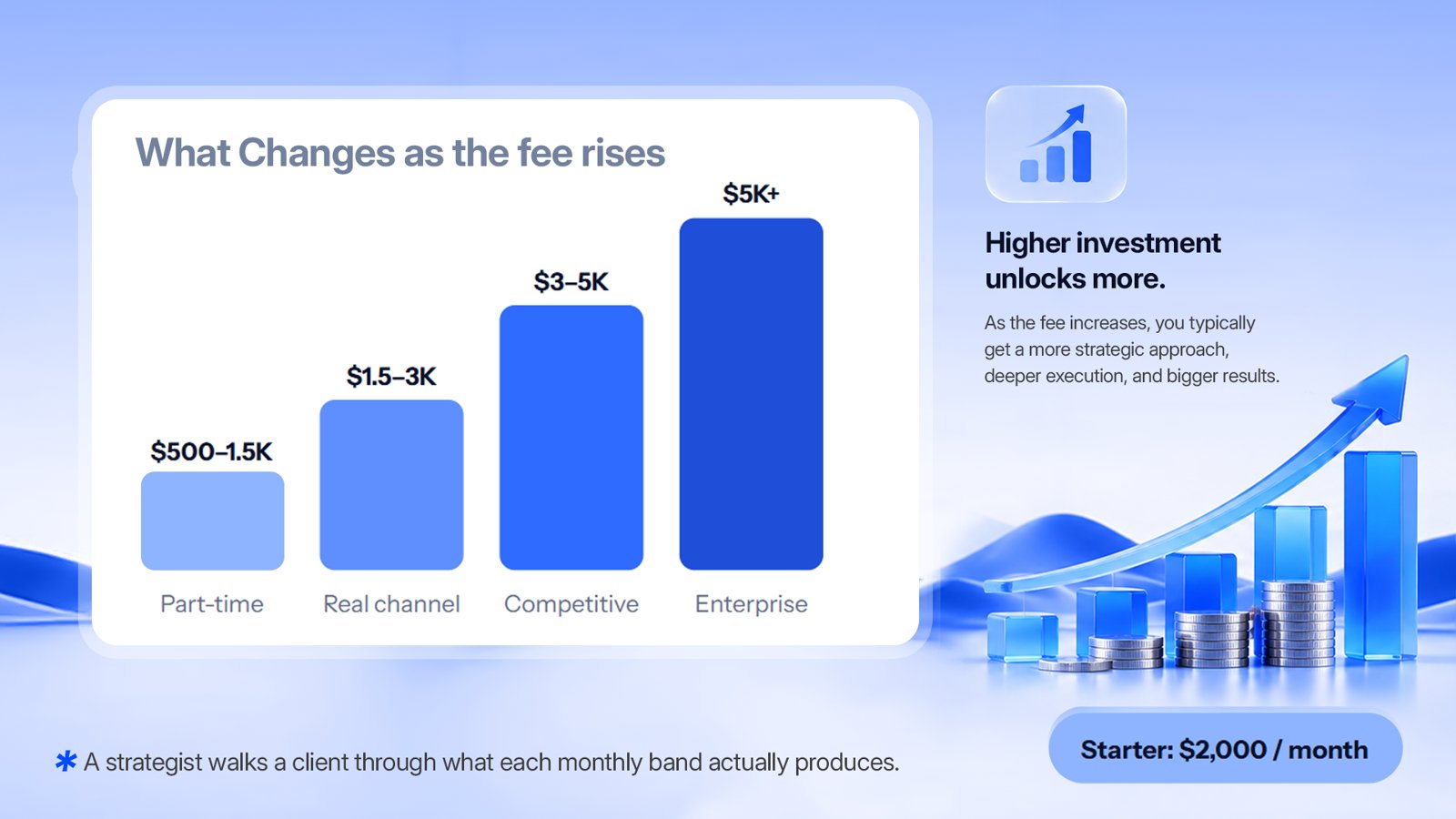
The clearest way to understand SEO cost is to look at what changes as the monthly fee goes up. The service list stays mostly the same from one tier to the next. What changes is how much of it gets produced each month.
$500 to $1,500 a month. At this level you’re typically getting a part-time effort: a Google Business Profile tune-up, basic on-page fixes, maybe one piece of content a month, and a monthly report. It works for a single-location business in a small market with little competition. It struggles anywhere else, because there isn’t enough production to move rankings against companies publishing weekly.
$1,500 to $3,000 a month. This is where most small businesses land and where SEO starts to behave like a real channel. Expect several content pieces a month, a handful of earned backlinks, technical SEO handled on an ongoing basis, and a strategist reviewing the account rather than a template. Our Starter plan sits at $2,000 a month and includes four content pieces, two niche backlinks, a quarterly press release, and the full technical, on-page, and Google Business Profile work.
$3,000 to $5,000 a month. Competitive markets live here: legal, medical, home services in a major metro, ecommerce with a deep catalog. The difference is production volume and link authority. More pages get built, more links get earned, and press coverage becomes a regular part of the plan. Our Growth and Premium plans run $3,000 and $4,000 a month and scale content to six and eight pieces a month, links to four and six, and press to a monthly cadence at the top tier.
$5,000 a month and up. Enterprise and multi-location work. The scope is set by the market rather than a menu, so the number is scoped on a call. A second website is treated as a second business with its own plan.
SEO Cost by Type of Business
Where you need to rank changes the price more than how big your company is.
Local SEO. A business serving one city or a service area is competing for the map pack and “near me” searches. Published 2026 ranges run $1,000 to $5,000 a month depending on the number of locations, and most single-location businesses sit at the lower half. The work centers on the Google Business Profile, reviews, location pages, and local citations. Our local SEO services are included in every plan, and multiple locations don’t change the price, only the output does.
National SEO. Competing for the terms an entire country types means competing against companies many times your size. That takes domain authority built through links and press, and content depth across a whole topic rather than a few pages. Expect the $3,000 to $10,000 range to be the realistic one.
Ecommerce SEO. Online stores pay more because there are more pages to optimize and the technical work is heavier: product and category pages, faceted navigation, product schema, and feeds. Shopify’s 2026 guide puts ongoing ecommerce SEO at $2,000 to $10,000 a month and one-time projects at $5,000 to $30,000. Our ecommerce SEO services run inside the same plan structure, aimed at the product and category pages that turn searches into orders.
AI search. In 2026 a growing share of discovery happens inside ChatGPT, Gemini, Perplexity, and Google’s AI Overviews. It’s often priced as a separate line item. We include AI SEO in every plan because the work overlaps heavily with good SEO: clear, well-structured answers and citations from sources those models trust.
The Factors Behind the Price
Two businesses can ask for “SEO” and get quotes three times apart. These are the factors behind the gap.
- Competition in your market. Ranking a plumber in a town of 40,000 and ranking a personal injury firm in Houston are different jobs. The second one needs far more content and link authority to show up at all.
- Size and health of your site. A 10-page site with a clean build is quick to fix. A 500-page site with years of redirects, duplicate content, and slow templates needs months of technical work before new content can perform.
- How far you want to go, and how fast. A handful of local keywords is a small target. A national topic cluster is a large one. Faster timelines mean more production up front.
- How much of the work the agency does. Some retainers are advice-heavy and deliverable-light: a strategy call and a report. Others produce the content, earn the links, and make the fixes. The second kind costs more and is usually the one that moves rankings.
- Who’s doing the work. Senior specialists cost more per hour than juniors and templates. They also make fewer expensive mistakes, like a migration that drops half your traffic.

Where Low-Cost Plans Fall Short
A $300 a month SEO plan isn’t a scam by default, but it’s worth knowing what tends to be missing at that price so the comparison is fair.
- Content production. Writing, designing, and publishing a well-researched page takes hours of senior time. At very low prices, content is either thin, AI-generated without editing, or not included at all.
- Earned links. Real backlinks come from outreach, press, and relationships. Cheap plans often substitute directory listings or purchased links, which can get a site penalized.
- Technical work. Site speed, crawl errors, schema, and structure are the foundation. They’re often listed in a cheap plan and rarely touched after month one.
- A person who knows your account. The most expensive thing in SEO is a strategist’s attention. Low-cost plans spread one person across dozens of accounts, so decisions default to a template.
- Ownership of the work. Some low-cost providers build content, links, or even the site itself on assets they control. Ask what happens to the work if you leave.
None of this means the most expensive plan wins. It means the right comparison is what gets produced each month and who produces it, not the sticker price alone.
The Timeline to a Return
SEO is slower than ads and it compounds, which is why pricing runs on terms rather than a single month. In our experience, and in the guidance most agencies publish, the first 90 days go to technical fixes, foundation content, and the first links. Movement on existing pages often shows in months two to four, because tuning pages that already have signals is the fastest ranking win available. New pages and competitive terms take six to twelve months to earn their position. After that, the traffic you’ve built keeps arriving without a per-click cost, which is the point.
A fair way to think about return: if a $2,000 a month plan brings in two new clients a month worth $3,000 each, it has paid for itself three times over, and that traffic doesn’t stop when the invoice does the way paid traffic does. Our SEO vs PPC comparison covers how the two channels behave over time if you’re weighing both. If you’re also running paid search, our Google Ads management cost guide breaks that side down the same way.
SEO Plans
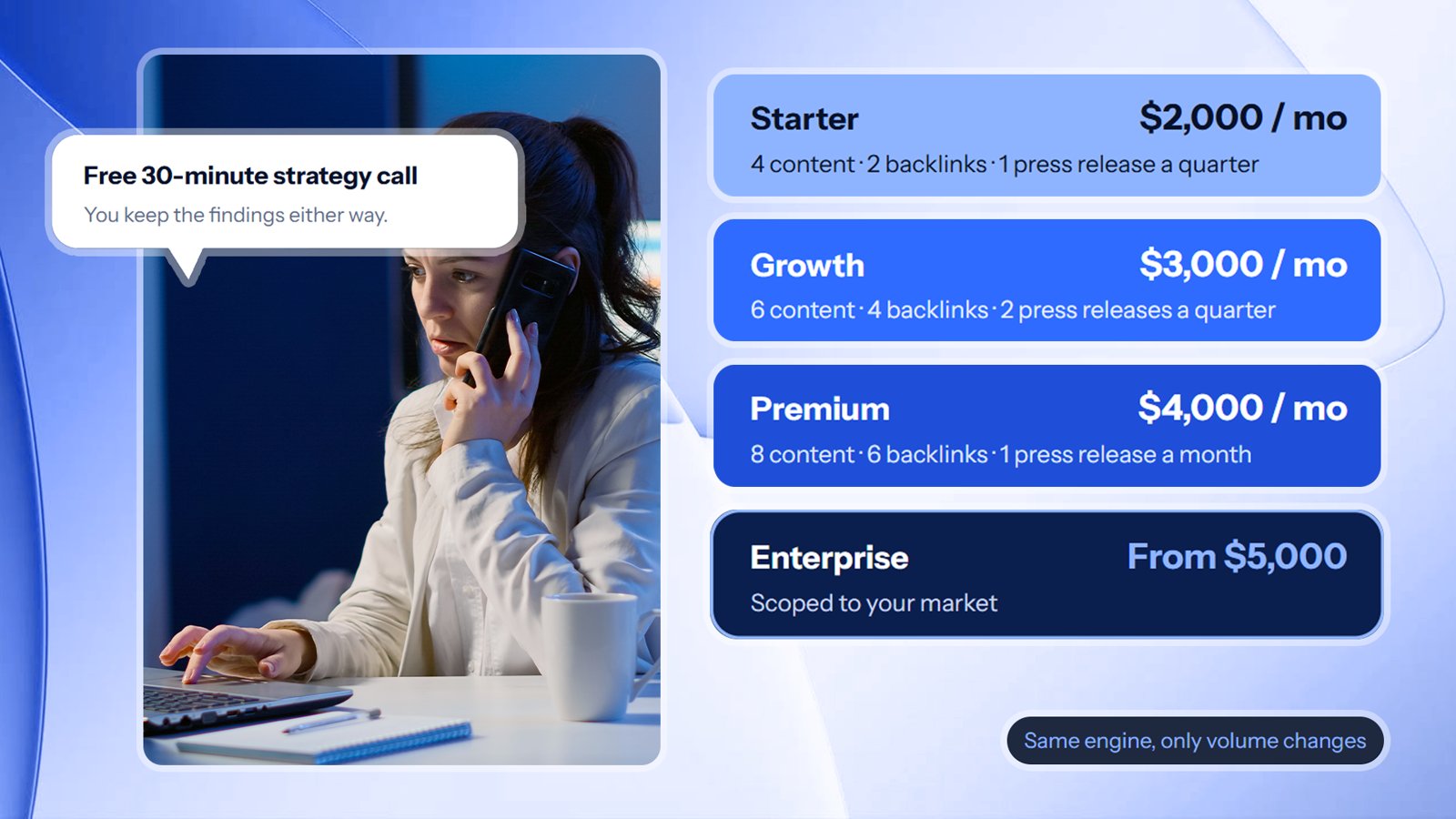
Every Lotiva plan includes the full engine: technical SEO, on-page optimization, content with custom graphics, earned backlinks, digital PR, AI SEO, Google Business Profile management, schema, strategy, and live reporting. The tiers change volume, not features.
| Plan | Monthly | Content pieces | Niche backlinks | Press releases |
|---|---|---|---|---|
| Starter | $2,000 | 4 a month | 2 a month | 1 a quarter |
| Growth | $3,000 | 6 a month | 4 a month | 2 a quarter |
| Premium | $4,000 | 8 a month | 6 a month | 1 a month |
| Enterprise | From $5,000 | Scoped to your market | Scoped to your market | Scoped to your market |
Local, national, and ecommerce SEO are covered in every plan. Full details are on the SEO pricing page.
Get a real number for your business
Book a 30-minute call. We’ll look at your market, your site, and who you’re up against, and tell you which volume fits and why.
Common questions
How much does SEO cost per month?
Most businesses pay $1,500 to $5,000 a month for an ongoing SEO retainer in 2026. Light local plans start around $500, and enterprise programs run $10,000 and up. Our plans run from $2,000 to $5,000 a month.
How much does SEO cost for a small business?
A small business in a single market typically pays $1,000 to $3,000 a month. Below $1,000 the work is usually part-time and limited to basic fixes and a Google Business Profile. Between $1,500 and $3,000, content, links, and technical work are produced every month, which is where rankings start to move.
How much does local SEO cost?
Local SEO runs $1,000 to $5,000 a month in 2026 depending on how many locations you have and how competitive your city is. Most single-location businesses sit between $1,000 and $2,500. With Lotiva, local SEO is part of every plan rather than a separate service.
Can I do SEO on my own?
Yes, parts of it. Claiming and completing your Google Business Profile, asking customers for reviews, and fixing obvious page titles are all doable in-house. Content production, link earning, and technical work are where most owners run out of hours, and that’s usually when a plan makes sense.
Is it worth paying for SEO in 2026?
For most businesses whose customers start with a search, yes. The channel is slower than ads and it compounds, so the traffic you build keeps arriving without a per-click cost. The exceptions are very new businesses with no site and companies in markets where almost nobody searches, where ads or referrals come first.
Is SEO dead now that AI answers questions?
No. AI Overviews and assistants like ChatGPT pull their answers from pages that are well structured, clearly written, and cited elsewhere, which is the same work good SEO has always done. What changed is where the answer appears, not the work that earns a place in it.
How long does SEO take to work?
Expect the first 90 days to go to foundations, movement on existing pages in months two to four, and competitive new terms to take six to twelve months. Results compound after that.
Is there a contract?
Yes. Plans run on 3, 6, or 12 month terms, and your rate is price-locked for the full term you choose. The work runs in quarterly sprints: every 90 days your plan is mapped, executed, and reviewed.

Lily Andrews
Founder of Lotiva. Over a decade helping small businesses grow with SEO, paid ads, and AI search. Connect on LinkedIn.